PPE Compliance Monitoring in Manufacturing: What Happens Between Safety Checks

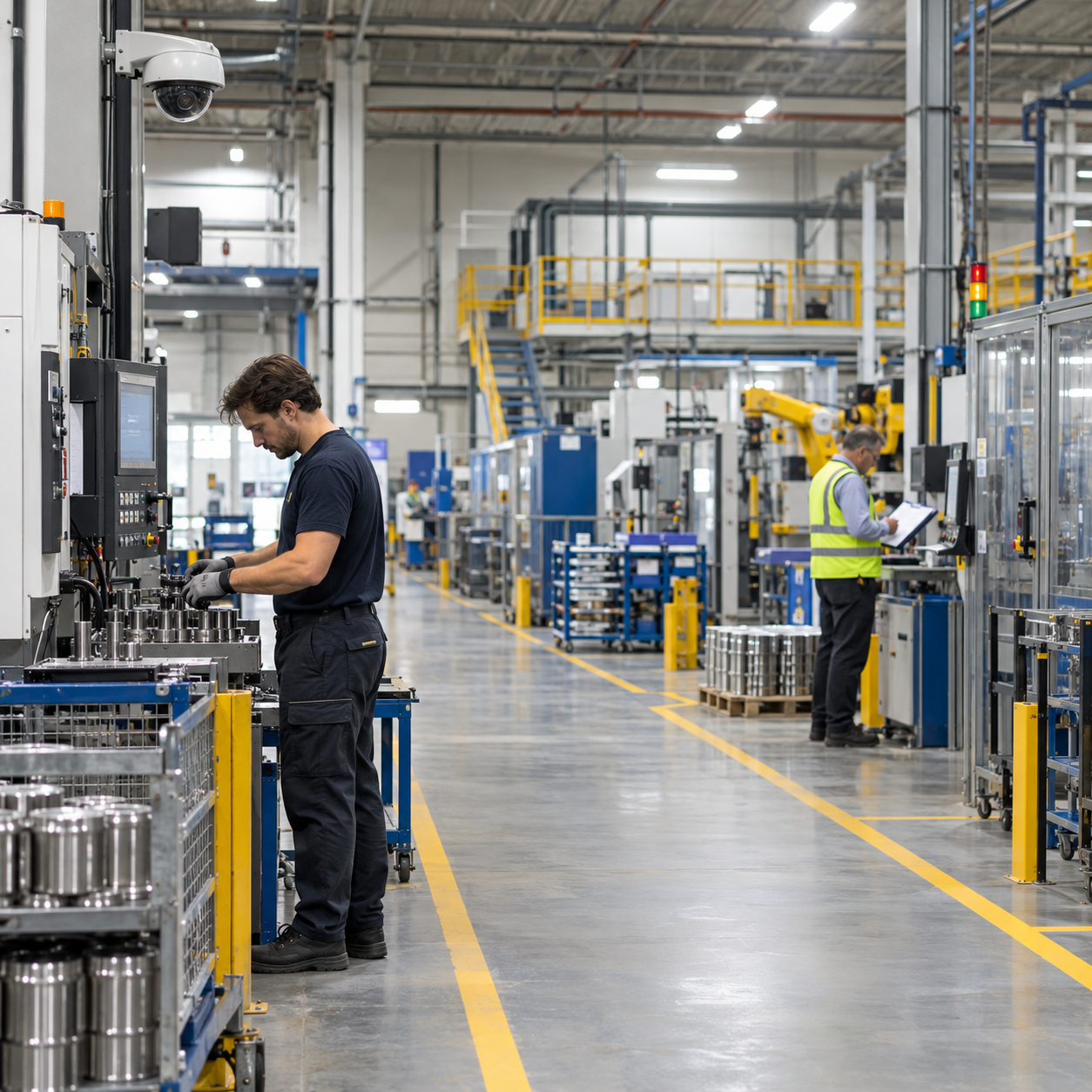
PPE violations often happen between safety rounds. See how manufacturers can use existing CCTV to monitor PPE compliance, understand recurring gaps, and alert teams when required protective equipment appears to be missing.
It is 2:17 in the afternoon on a production floor. A worker entered the area wearing the required helmet, safety vest and eye protection. Later in the shift, the goggles are pushed up while work continues. A few minutes later they are back in place.
The supervisor is inspecting another part of the plant. The CCTV camera records the entire sequence. By the time the next safety round reaches the area, everything looks correct.
That is one of the practical problems with PPE compliance. A safety inspection can tell you what was happening when the inspection happened. It cannot automatically tell you what happened during all the minutes between checks.
For manufacturers, the question is therefore not only whether workers were issued the correct PPE or passed a shift-start check. It is whether the required protection remained in use while the worker was exposed to the relevant hazard.
PPE compliance is not the same as issuing PPE
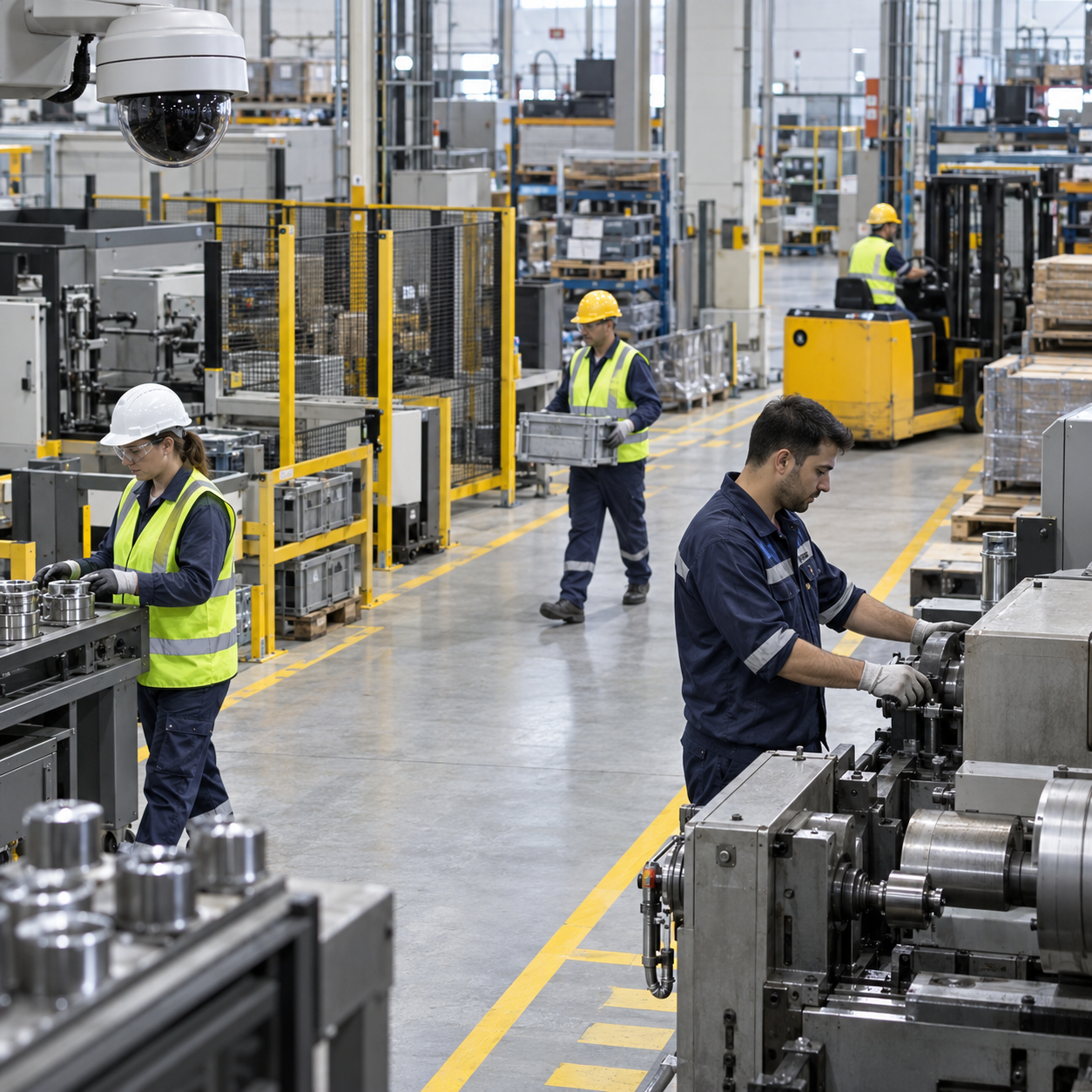
Personal protective equipment sits inside a much larger safety process. In the United States, OSHA's general-industry PPE standard requires employers to assess workplace hazards, select PPE appropriate to those hazards, ensure affected employees use it, and train workers on when PPE is necessary and how it should be worn.
The important point is that PPE requirements begin with the hazard. A helmet may be mandatory in one area. Eye protection may become necessary around grinding or cutting operations. Gloves may depend on the material or process being handled. Other areas may have different requirements entirely.
So a useful PPE compliance system cannot begin with: Does this worker have PPE? It needs a more operational question: Is this person wearing the PPE required for this location and activity?
That is also why PPE compliance belongs within the wider context of AI video surveillance for manufacturing facilities.
The manufacturing problem is not simply recognising an object such as a helmet. It is applying the right safety rule to the right part of the factory.
Research shows why occasional observation is not enough
PPE non-compliance is not a hypothetical problem. A 2025 systematic review and meta-analysis examined 18 studies involving 7,612 workers across industries including manufacturing, construction, mining and agriculture. Among the 15 studies included in its PPE-use analysis, the pooled prevalence of PPE use was approximately 51%.
That figure needs to be interpreted carefully. The studies covered different industries, countries, workplaces and types of equipment, and statistical heterogeneity was extremely high. It would be misleading to say that manufacturing plants generally have "51% PPE compliance."
What the research shows more reliably is that PPE use varies substantially between environments. The review also found recurring barriers including lack of PPE availability, discomfort, inadequate training and attempts to save time. [2]
Research specifically involving manufacturing workers points in the same direction: safety behaviour does not exist independently of the organisation around it. A Safety Science study involving 3,970 manufacturing workers across 42 companies examined management commitment, supervision, training, PPE behaviour and workplace injuries. The researchers found significant relationships between safety climate, safety behaviour and occupational injuries.
That matters operationally. If the same PPE violation keeps appearing, the right question may eventually stop being: Who forgot their PPE? and become: Why does this keep happening here?
One PPE rule does not fit the whole factory
Imagine a worker moving through three areas during the same shift. In the first area, a high-visibility vest and safety shoes are required. In the second, the worker enters a hard-hat zone. In the third, an operation introduces an eye-protection requirement.
The person has not changed. The compliance rule has. That is why PPE monitoring should normally be configured around zones and site-defined safety rules, rather than treating the entire camera frame or factory as having one universal requirement.
A practical rule could be: Grinding Zone A -> worker present -> helmet + eye protection required -> required PPE appears missing for a defined period -> create event
Another area may use a completely different rule.
And where the operational requirement is specifically head protection rather than broader PPE, manufacturers can treat that as a narrower helmet detection problem.
The safety team still determines what PPE is required. The camera analytics monitors whether the defined visual condition appears to be met.
The camera has to see the PPE before AI can monitor it
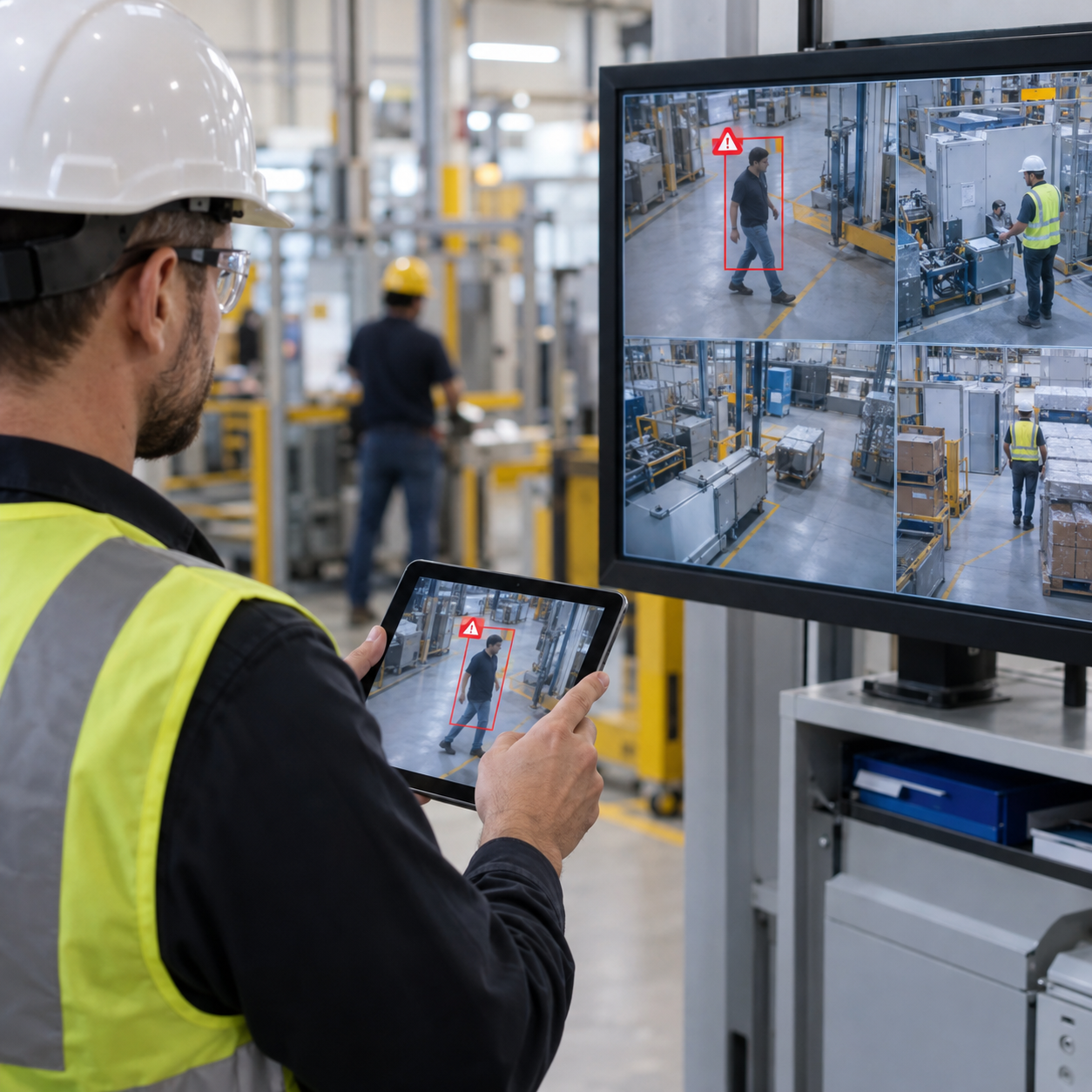
This sounds obvious, but it is one of the most important parts of a real deployment. A camera can provide an excellent overview of a production floor and still be unsuitable for detecting a particular piece of PPE.
Consider safety glasses. From twenty metres away, a worker may occupy only a small part of a 1080p frame. The camera can clearly show that a person is present, while the eye-protection area occupies very few pixels. A high-visibility vest is much larger and may be easier to distinguish.
Gloves introduce a different problem. Hands move quickly, disappear behind machinery and tools, overlap with other objects and may occupy only a tiny part of the image. Footwear may be hidden behind equipment or outside the camera frame entirely.
Camera angle matters too. A steep overhead view may be useful for tracking movement but provide a poor view of a worker's face. A lower angle may show the torso clearly while machinery repeatedly blocks the hands.
This is the same principle covered in our guide to choosing the right security camera.
There is no universally "AI-ready" camera. The useful question is: Can this camera see the specific evidence this use case requires?
Real factories are harder than AI demonstrations
Computer-vision demonstrations are usually clean. Real factories are not. Workers overlap. Forklifts pass through scenes. People turn away from cameras. Helmets may be partly hidden. Uniforms vary. Lighting changes during the day. Dust, glare and shadows affect the image. Equipment can block parts of the body.
A 2026 systematic review of computer-vision technologies for PPE compliance monitoring examined these deployment problems directly. It identified illumination changes, occlusion, viewing-angle variation, worker movement, computational constraints and the difference between laboratory validation and industrial deployment as important challenges. [4]
This is why a model's benchmark accuracy should not be confused with the accuracy a particular factory will receive from every camera. The practical unit of evaluation is closer to: PPE item + camera + distance + angle + lighting + operating environment
A hard-hat model performing well on a close, unobstructed entrance camera does not prove that the same system will reliably identify gloves on a worker partly hidden behind a machine. Testing should happen on the site's footage.
PPE detection is not simply "helmet: yes / no"
There is another complication. A camera sees pixels. A safety procedure understands hazards. Those are not the same thing.
Suppose a worker is standing next to another worker who is wearing a helmet. Detecting a helmet somewhere near the two people is not enough. The system needs to associate the visible PPE with the correct person.
The same applies in crowded scenes. Three workers and three helmets in one image do not automatically mean all three workers are compliant.
The useful question is person-specific: Which PPE belongs to which worker?
Time matters as well. A helmet disappearing for one frame because a beam crosses the worker's head is different from a worker remaining visibly without a helmet in a hard-hat zone. That is why practical video analytics usually combines object detection with tracking, zones, time thresholds and operating rules rather than treating each frame independently.
Our broader guide to video surveillance analytics explains the same principle across other camera-based use cases.
For PPE, the distinction is especially important because a badly designed system can generate hundreds of alerts for temporary visual uncertainty rather than meaningful safety events.
Not every missing-PPE frame should become an alert
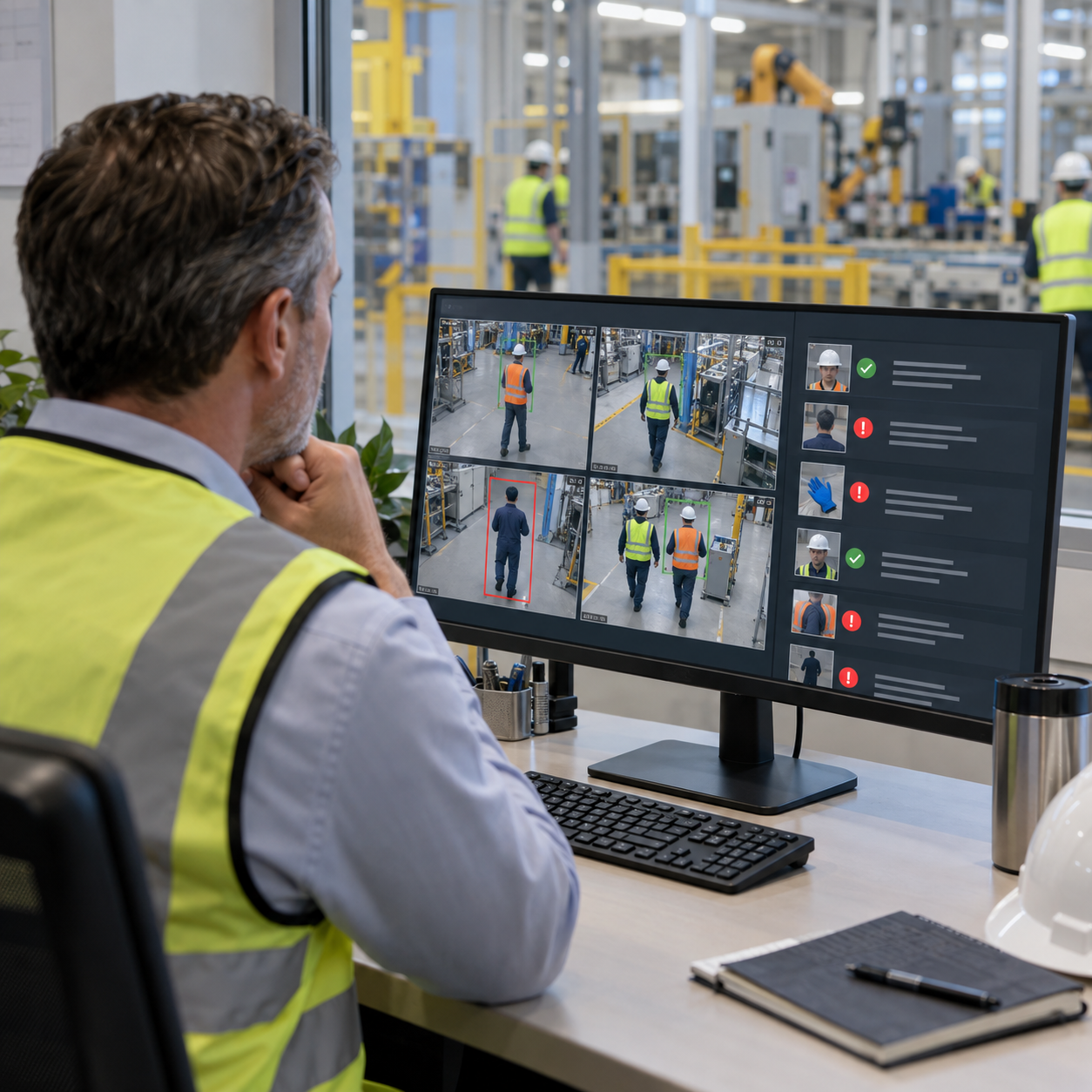
Suppose a worker walks behind a column. For a moment, the helmet is no longer visible. Or a worker bends beneath equipment and their upper body disappears. Or another employee crosses directly between the worker and camera. The model may temporarily lose visual evidence of the PPE. That does not necessarily mean a safety violation occurred.
A useful system therefore needs an operating rule around persistence. For example: PPE appears missing -> condition continues beyond configured tolerance -> violation event created
The tolerance should not be universal. A factory may want different rules for different zones, PPE types and levels of risk. The purpose is not to hide genuine violations. It is to reduce alerts caused by momentary occlusion or visual uncertainty. This is also something that should be measured during a pilot rather than guessed in advance.
What continuous PPE monitoring actually adds
FlowLinks' AI PPE Detection for Manufacturing can use suitable existing CCTV feeds to monitor configured PPE requirements across selected factory zones.
The workflow can be kept simple: Existing CCTV -> worker detected -> zone rule applied -> required PPE checked -> violation persists -> FlowLinks creates event -> alert + visual evidence -> supervisor reviews
The important part is not that AI can recognise a helmet. A supervisor can recognise a helmet. The useful part is that software can monitor configured camera feeds continuously instead of depending on someone looking at the correct screen at the exact moment a violation occurs.
FlowLinks can also retain the event with its time, camera, zone and associated visual evidence, making individual incidents easier to review later. That turns CCTV from something used mainly after an incident into something that can also surface a safety condition while the operation is still running.
Detection only matters if it reaches the right person
Finding a PPE violation is still only the first step. A practical workflow needs to connect detection to the person who can respond: Violation detected -> FlowLinks alert + evidence -> shift or EHS supervisor reviews -> corrective action -> event recorded
This is where the historical record becomes useful too. One isolated missing-helmet event may require a straightforward correction. Thirty similar events are more interesting.
If missing eye protection repeatedly appears in the same production area, during one shift or around one activity, the problem may require more than another warning. Perhaps the PPE is uncomfortable in that environment. Perhaps replacements are difficult to access. Perhaps a task makes the equipment difficult to keep in place. Perhaps contractors are not receiving the same induction as permanent workers.
FlowLinks helps establish where, when and how often a visible compliance condition occurred. The factory's safety team determines why it is happening and what should change. That distinction matters. The value of monitoring is not the number of alerts generated. It is the ability to turn repeated observations into something the safety team can investigate.
What should a PPE monitoring pilot actually measure?
A PPE pilot should not be judged by how many bounding boxes appear correctly on a demonstration screen. And it should not be judged by the number of alerts generated. More alerts can actually indicate a poorly configured system. The useful measurements are operational.
Measure | What to establish |
|---|---|
Detection performance | Of the visible, reviewable PPE violations, how many did the system identify? |
False alerts | How many events were caused by occlusion, camera angle or other visual uncertainty rather than genuine non-compliance? |
Camera suitability | Which PPE items can each camera actually see reliably at normal working distances? |
Alert-to-review time | How quickly does the responsible supervisor receive and review an event? |
Repeated violations | Are the same PPE issues recurring by zone, shift or time period? |
Event quality | Does the captured image or clip provide enough evidence for a supervisor to understand what happened? |
Compliance trend | Does observed non-compliance reduce over comparable operating periods after interventions are introduced? |
There is an important reason to measure false alerts alongside misses. A technically impressive system that repeatedly sends supervisors incorrect warnings will eventually be ignored. Operational trust is part of system performance.
What CCTV-based PPE monitoring cannot tell you
There are also limits to what a camera can prove. Computer vision may be able to determine that a visually distinguishable helmet, vest or other configured PPE item appears to be present on a worker. That does not mean it can verify every aspect of protection.
A conventional CCTV image cannot perform a respirator fit test. It cannot reliably establish the protective rating of two visually similar gloves. It cannot prove that footwear meets a particular certification simply because it resembles a safety shoe.
Even something as apparently simple as "wearing a helmet" can contain details that are difficult to verify from distant CCTV footage, such as fit or fastening.
There are physical limits too. If the relevant PPE is outside the frame, hidden behind machinery, too small at the worker's distance from the camera or obscured for most of the task, software cannot recreate visual information that the camera never captured.
That is why FlowLinks should begin with the footage and operating requirement: What PPE matters here? Where is it required? Can this camera see it? What should count as a violation? What should happen when the condition persists? Only then does the detection model become useful.
The question is not whether everyone passed the morning PPE check
A worker can be fully compliant at 9:00 a.m. and visibly non-compliant at 11:17. A contractor can enter correctly equipped and remove protection later. A supervisor can complete a successful safety round while a violation occurs five minutes afterwards in another part of the plant. That is the gap continuous monitoring is designed to reduce.
The operational question is not: Did everyone look compliant when we checked? It is: When required PPE appeared to be missing in a monitored risk area, did we know while there was still time to respond?
The cameras may already be recording the answer. The challenge is turning that recording into an operational event.
See PPE compliance on your existing factory cameras
Before adding cameras or assuming every PPE category can be monitored, FlowLinks can evaluate the CCTV views already available at the plant. The useful starting point is straightforward: select a real production area, define the PPE rule, review the camera geometry and test the system against actual working conditions. That shows what the current footage can detect reliably, where the limitations are and whether alerts provide enough evidence to be useful to the safety team.
Pro Tip:
Start with one real production zone and one clearly defined PPE rule. Validate whether the existing camera angle, distance, lighting, and visibility are good enough to detect that PPE reliably before expanding monitoring across the plant.
Conclusion
PPE compliance is not a one-time check. Violations can happen between supervisor rounds, vary by zone, and go unnoticed when no one is watching the right camera. With suitable existing CCTV, FlowLinks can help manufacturers monitor configured PPE requirements, surface persistent non-compliance, and retain visual evidence for review. The goal is not to replace safety teams or existing controls, but to give them better visibility into where, when, and how often compliance gaps occur.
Evaluate Your Existing Cameras
See how your current CCTV views can be used for AI PPE detection.
Book a 20-minute demoSources & Citations
- 1.Occupational Safety and Health Administration (OSHA). 29 CFR 1910.132
- 2.Santos, W., Lorente, A., Rojas, C., Mariscal, G., & Lorente, R. (2025)
- 3.Safety climate, safety behavior, and worker injuries in the Chinese manufacturing industry
- 4.Systematic Review of Computer-Vision Technologies for Personal Protective Equipment Compliance Monitoring
- 5.Occupational Safety and Health Administration (OSHA)