How to choose the right security camera without wasting money

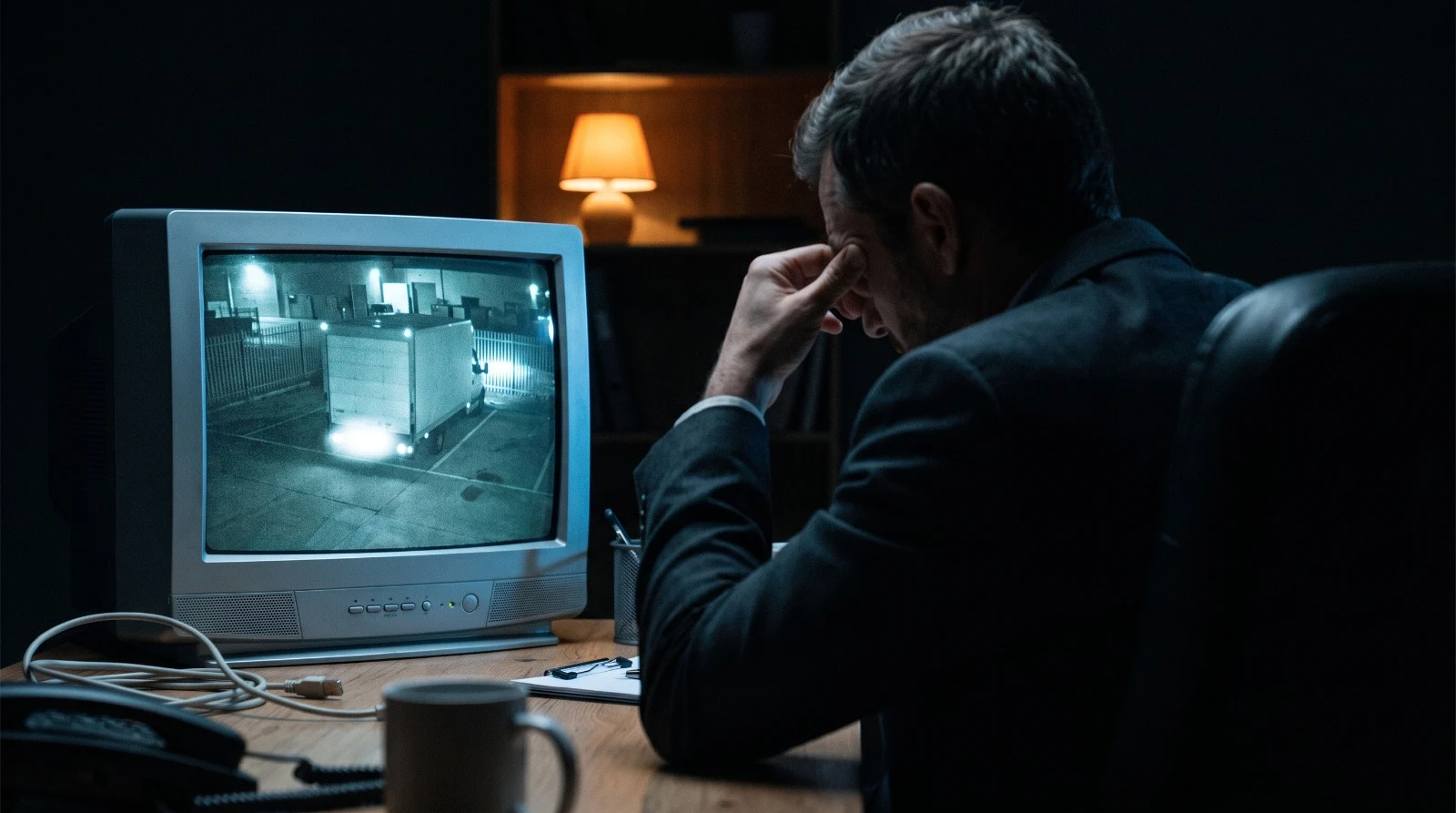
A good camera in the wrong place, in the wrong conditions, can't see what you need.
Marcus runs a warehouse — Meridian Storage & Logistics, a mid-sized operation with a busy yard, a handful of loading docks, and a gate that trucks roll through all day. He did everything right. He bought good cameras — not the cheapest — and covered the yard, the docks, and the gate. He spent real money, and the footage looked sharp.
Then one night a truck pulled out of his lot that shouldn't have. The next morning Marcus opened the recording to get the plate. The truck was right there — he could see its shape, its colour, the time to the second. But the one thing he needed, the characters on the plate, was a bright white blur. Unreadable.
He was furious, and fairly so. He'd paid for good cameras. So what went wrong?
Nothing he could see on the box. The plate failed for reasons no price tag warns you about: at night the camera switched to infrared and slowed its shutter, the truck was moving, and the camera was mounted high for coverage — not low and head-on for plates. A licence plate needs about 100 pixels across it and a fast shutter to freeze motion. His camera gave neither, on that plate, in those conditions. And no software can recover detail the lens never captured
That's the gap this guide closes — the distance between "good cameras" and the right camera for the job and the conditions it runs in. The number most people buy on, megapixels, isn't the one that decides what you see. What matters is how many pixels land on the thing you care about — and whether the camera can see it at all in the dark, the rain, or the glare of a doorway.
This guide is for the owner standing in their shop, warehouse, clinic, or parking lot, trying to figure out which camera to put where — and why one costs three times another. By the end you'll read any spec sheet and know what each number buys you. No jargon. Just two questions.
Still confused by terms like WDR, FPS, aperture or focal length? Read our guide to what your CCTV spec sheet actually means →
The whole decision comes down to two questions
Every good camera choice answers two things, in this order.
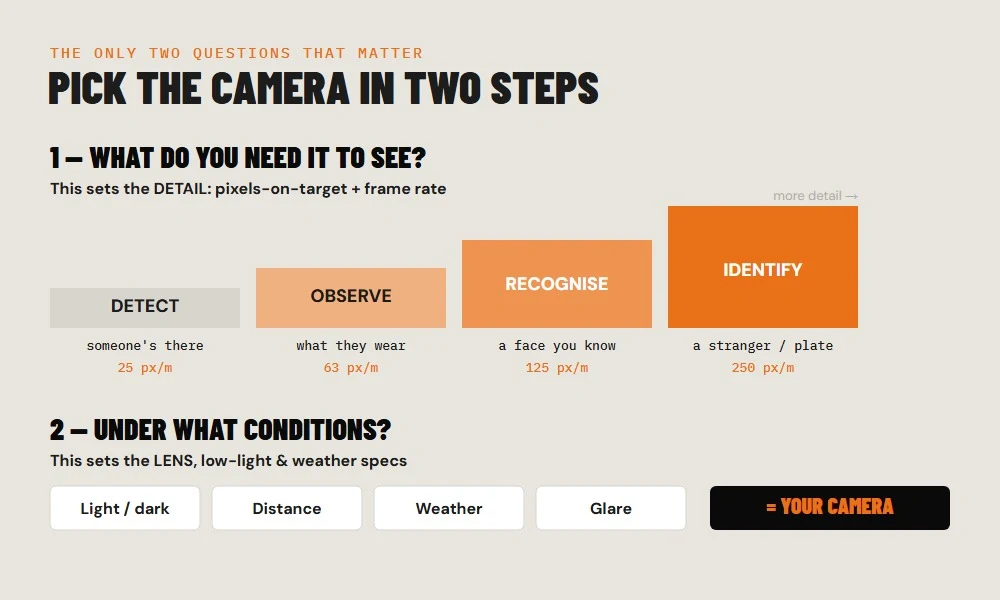
One: what do you need it to SEE? Just that someone is there? What they're wearing? A face you can recognise? A licence plate? This sets how much detail you need — the pixels-on-target and the frame rate.
Two: under what CONDITIONS? How much light, how far away, how much weather and glare? This sets the lens, the low-light ability, and the weatherproofing.
A "setting" — a parking lot, a restaurant, a hospital corridor — is just a bundle of those two answers. Once you can answer both, you can spec a camera for any situation, including ones no guide lists.
Question one: what do you need it to see?
There's a published standard for this, used across the industry, called DORI — Detect, Observe, Recognise, Identify (IEC 62676-4). Each step needs more pixels on the target than the last.
Detect — "someone is there." About 25 pixels per metre of scene.
Observe — "I can see their clothing, and count how many." About 63 px/m.
Recognise — "that's a face I know." About 125 px/m.
Identify — "I can name a stranger from this footage." About 250 px/m, or roughly 40 pixels across the face.
The jump matters: identifying a stranger needs about ten times the pixels of simply spotting one. A face needs enough pixels between the eyes — somewhere from 35 px in good conditions up to 100 px to be safe.Below that, no system can put a name to it. The TV trick where they "zoom and enhance" a blur into a sharp face is fiction.
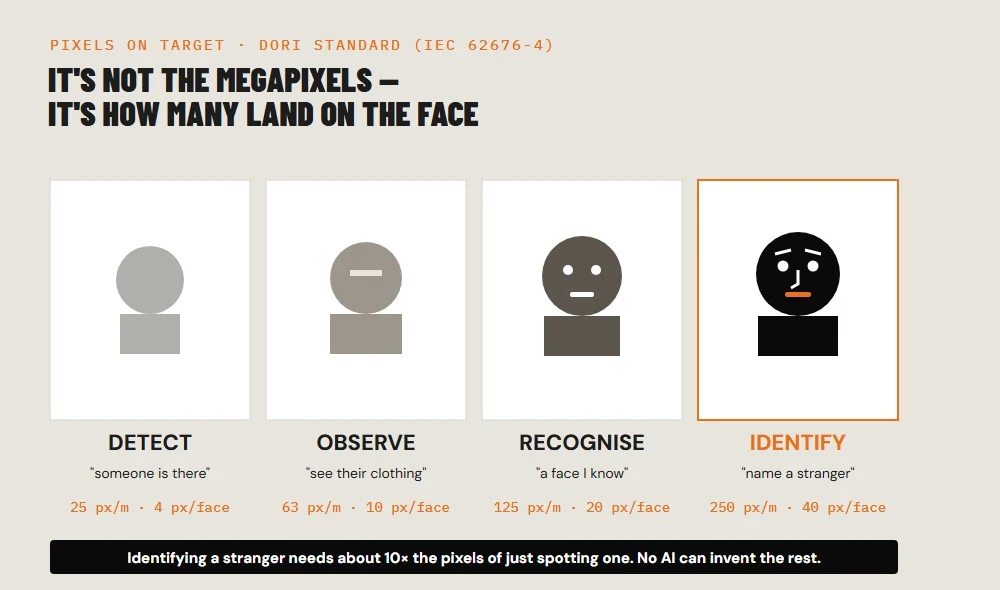
So before you look at a single product, decide which rung you actually need. Counting customers? You're at Observe — you need far less camera than you think. Putting a name to a face at the back door? You're at Identify — and most cameras quietly fall short there.
Question two, part one: the lens decides wide vs far
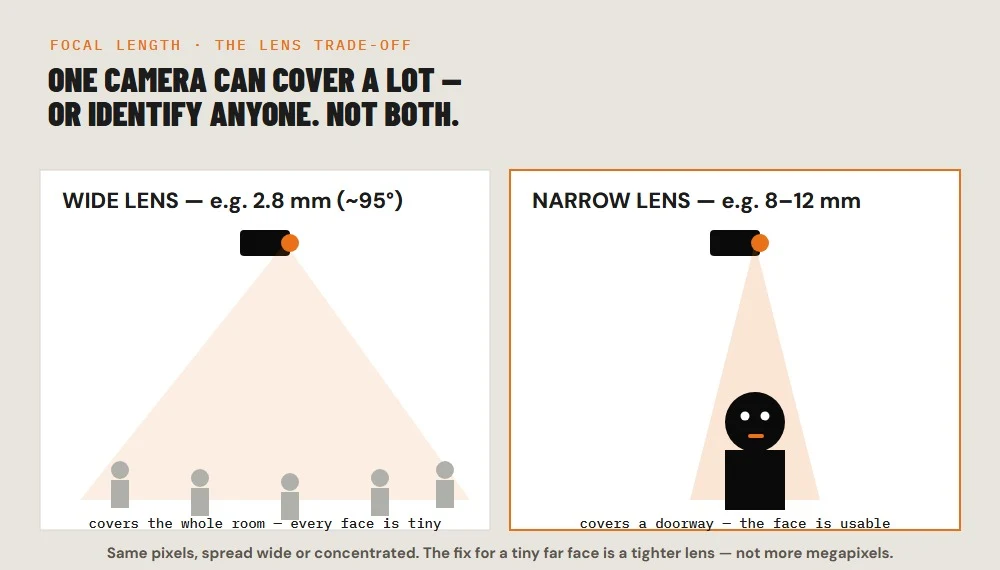
Here's the trade-off that catches everyone. A camera's lens — its focal length, measured in millimetres — sets how wide a view it covers. A short lens (say 2.8 mm) sees a wide angle, around 95°. A longer lens zooms in and sees a narrow slice.
The same pixels get spread across whatever the lens covers. Go wide to cover a whole room, and every face in it gets tiny. Zoom in to read a face, and you lose the rest of the room.
One camera cannot cover a large area and identify people in it. If you widen the view enough to watch the whole driveway, you lose face and plate detail. If you tighten it enough to identify a driver, you lose the surroundings. The fix for "I can't see the face at the back" is almost never more megapixels — it's a tighter lens, or a second camera aimed at the spot that matters.
That is the difference between buying cameras and designing an AI camera setup for warehouses. The camera has to match the job — one angle for the yard, another for the loading dock, another for PPE checks, and a separate one for licence plates at the gate.
Question two, part two: where you put it matters as much as what you buy
You can buy the right camera and still get useless footage by mounting it wrong.
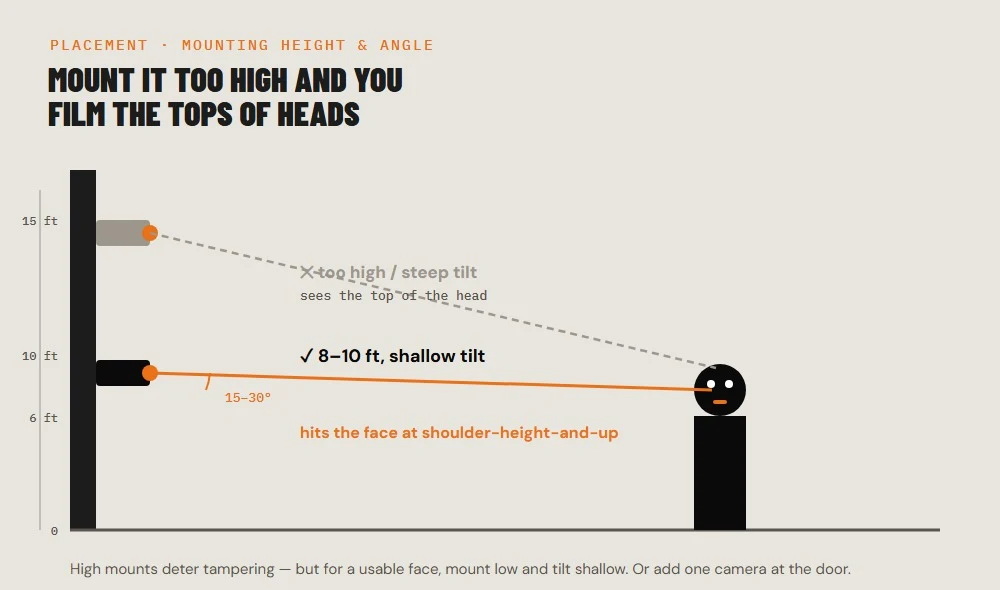
For faces, mount low and shallow — about 8 to 10 feet high, tilted down only 15 to 30 degrees. Mount it higher or tilt it steeper and you film the tops of people's heads, which identifies no one.High mounts deter tampering and cover more ground — they're for context, not for faces.
The honest move when you need both: pair a wide overview camera with one dedicated camera at the choke point — the doorway everyone passes through — mounted at face height with a narrow view. That one camera does your identifying; the others do your watching.
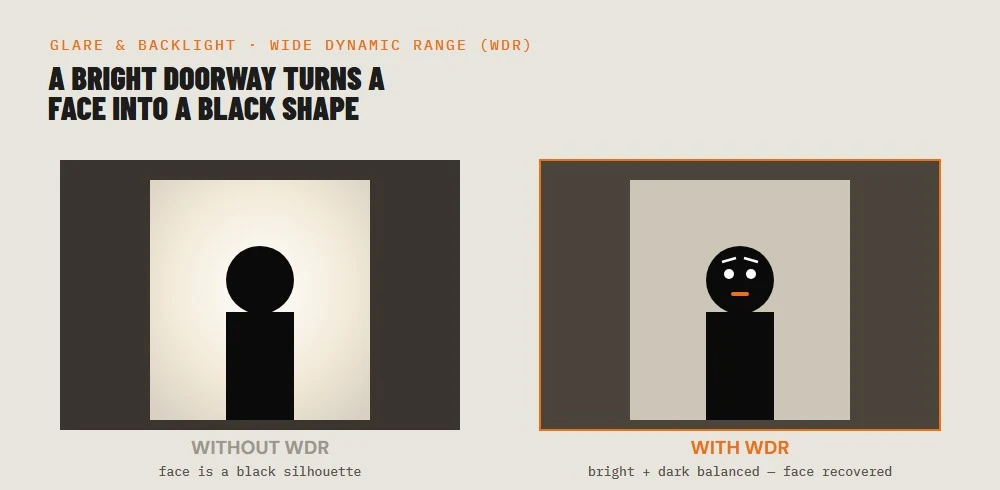
One more placement trap: don't point a camera into a bright doorway or the setting sun. The backlight turns faces into black silhouettes. Aim across the light, not into it.
Question two, part three: can it see in the dark, rain, and glare?
This is where cheap cameras fall apart, and where the price differences live.
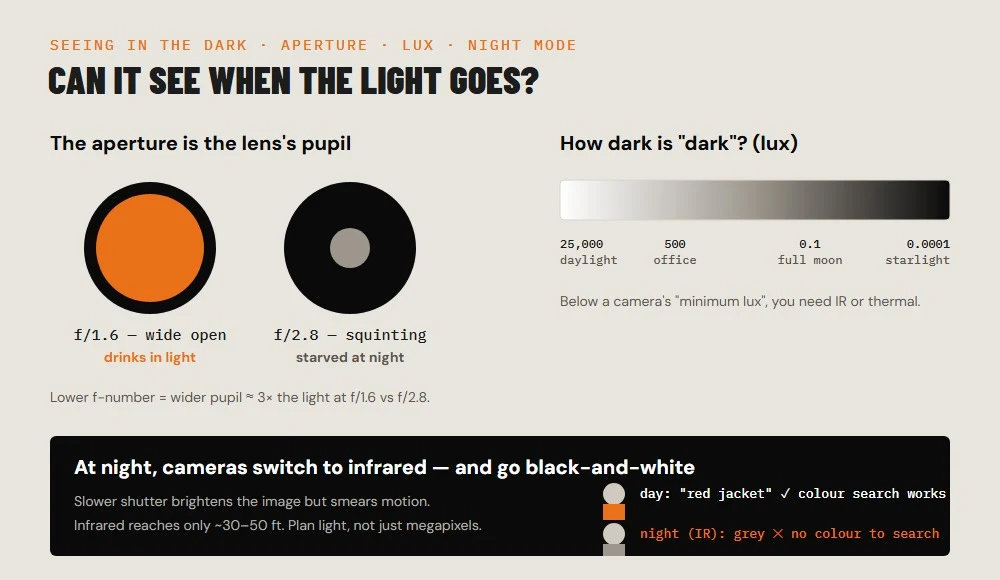
Aperture (the f-number) is the lens's pupil. A lower f-number — f/1.6 versus f/2.8 — is a wider pupil that drinks in more light.By the math, f/1.6 lets in roughly three times the light of f/2.8. At night, that's the difference between a usable image and noise.
Minimum lux tells you how dark a camera can still see. For reference: daylight is 10,000–25,000 lux, an office is 320–500, full moonlight is around 0.1, and starlight is a thousandth of that.Below a camera's rated lux, it needs infrared or thermal to see anything.
But infrared night vision comes with a catch most buyers don't know: at night the camera switches to infrared and the picture goes black-and-white. So if your plan was "search for the man in the red jacket," that only works in daylight. At night there's no colour to search. Infrared also only reaches about 30–50 feet.
Wide Dynamic Range (WDR) handles scenes that are bright and dark at once — a sunlit entrance, a shaded loading bay. Without it, a backlit doorway hides the face of everyone who walks through. With it, the camera balances both.If a camera will ever face a window or a doorway, WDR is not optional.
Outdoors, check two ratings. The IP rating is the weather seal: IP66 means dust-tight and able to take powerful water jets — the outdoor baseline — and IP67 adds brief submersion.The IK rating is impact resistance: IK10 is the toughest, worth it anywhere the camera is within reach, like a school or a low wall.One warning: "weatherproof" only describes the seal. It says nothing about whether the camera sees well at night or through rain — that's a separate spec to check.
When a normal camera simply won't do it: thermal and fire
Some jobs are beyond any ordinary camera, and it's worth knowing where the line is — so you don't buy the wrong thing and blame it later.
A thermal camera sees heat instead of light. It works in total darkness and sees through light smoke and fog, where a normal camera goes completely blind. The trade-off is total: it gives you no detail. You can tell a person is there, but never who they are — no face, no plate.(That blindness is also a privacy advantage in sensitive areas.) Thermal also runs at much lower resolution, 320×240 to 640×480, and costs more.
So the rule is simple. Use a normal camera when you need to see who or what. Use thermal when you only need to know that something is there in conditions a normal camera can't handle — total darkness, smoke, fog, or long-range perimeter. And read thermal "detection range" honestly: a thermal detects a person about four times farther than it can recognise one.
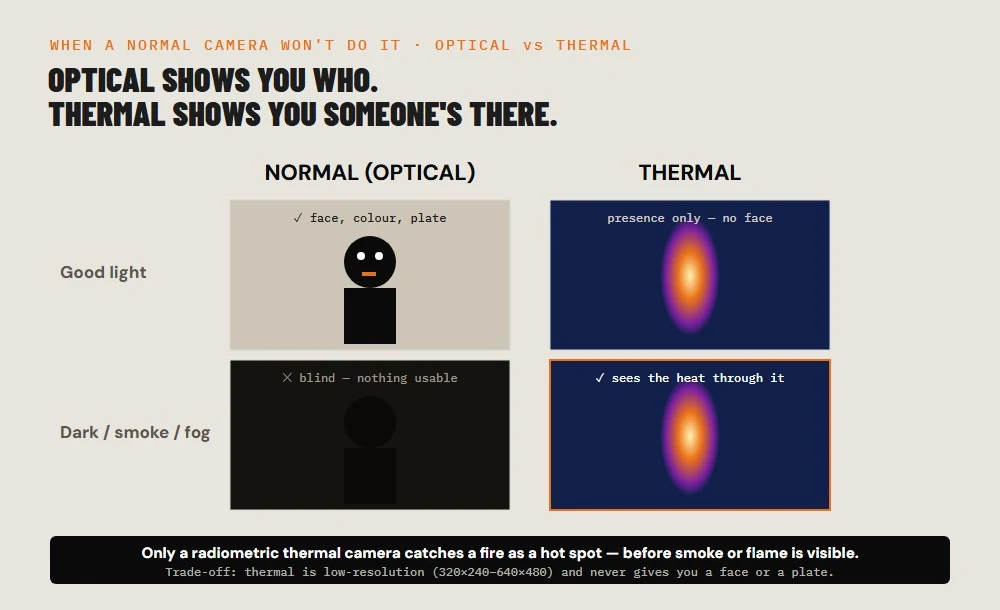
Fire is the clearest example. A normal camera can spot smoke or flame once it's visible in the frame — useful, but it only triggers after the fire shows itself, and it's not a substitute for a code-listed smoke detector.Only a temperature-measuring (radiometric) thermal camera catches a fire as a rising hot spot before any smoke or flame appears — which is why warehouses, electrical rooms, and data centres use them.
Special jobs, special setups
A few common goals need their own approach:
Licence plates. Plates need about 100 pixels across to read, a dedicated camera aimed nearly head-on at a shallow angle, and a fast shutter to beat motion blur.[S7][S64][S31] A steep top-down view kills the read. This is always a separate camera from your overview.
Gender, age, clothing — counting and describing people. This sits at the Observe-to-Recognise level, so it needs roughly half the pixels of a full face identification.It's also anonymous: it counts and describes, it doesn't put a name to anyone — no face stored, no identity database.Remember the night rule: colour-based description only works in daylight.
Floor hazards, PPE, and cleaning. Detecting a spill on the floor or a missing hard hat needs far less detail than a face — but it needs a good high or overhead angle and decent light, because reflections on a wet floor are genuinely hard. Catching a fall needs frame rate: a slow camera misses the moment.[S59] (Falls send around 8 million people to US emergency rooms a year, so the stakes are real.)
Frame rate in one line: 15 fps is fine for slow scenes, 25–30 fps is standard, and 60 fps is for fast action like vehicles. And form factor: a bullet camera is a visible deterrent for outdoor range; a dome is discreet and vandal-resistant; a turret gives cleaner night infrared; a PTZ covers a lot but only looks one way at a time, so it misses whatever it isn't pointed at; a multi-sensor or fisheye replaces several cameras for a wide overview, but only identifies people close up
Put it together: the cheat-sheet matrix
Here's how the two questions resolve into real choices. "Drives the choice" is the one thing that matters most.
Setting | What you want it to do | Detail level | Light & weather | The one thing that drives the choice |
|---|---|---|---|---|
Retail floor | Spot concealment, see who's at the shelf | Observe→Recognise | indoor; WDR near windows | enough pixels on the aisle + see faces, not hats |
Store entrance | Identify people in and out | Identify (≥250 px/m) | WDR for backlit door | a tight camera at the door, separate from overview |
Restaurant doorway | Count customers, read gender/age (anonymous) | Observe→Recognise | daylight for colour | attributes need ~half a face-ID's pixels |
Warehouse aisle | PPE (hard hat, vest) compliance | Object detection | bright; WDR for dock glare | point at the work zone; big items are forgiving |
Loading dock | Read truck plates + activity | Read a plate (~100 px) | IR + fast shutter at night | a dedicated plate camera, near head-on |
Parking lot, night | Detect a person near cars | Detect→Observe, low light | low-light glass; IP66 | a low f-number lens + weather rating |
Parking lot, fire | Catch a fire before flames | Hot-spot, no detail | works in dark/smoke | only thermal sees heat early |
Hospital corridor | Falls + staff response | Detect a fast event | even indoor light | frame rate — slow cameras miss the fall |
Hospital floor area | Wet-floor spill + cleaning done | Object/zone state | WDR for floor glare | angle + light; reflections are hard |
School gate | Known-vs-unknown, vandal risk | Recognise | outdoor IP66; reachable | vandal-resistant IK10 + a face-height view |
Long perimeter, night | Know someone's there in the dark | Detect at distance | total darkness/fog | thermal to detect, optical to identify near |
For CCTV video quality for AI, this matrix is the part most people skip. The question is not, "Is the camera good?" The question is, "Is this camera good for this job, in this exact place, under these conditions?"
The AI reality — and what to do this week
Here's the honest part. Detection software is forgiving. It tolerates a lot of imperfect footage. But it cannot invent detail the camera never captured.The camera sets a floor that no software beats. Get the camera and its placement right, and the rest works. Get them wrong, and no amount of processing rescues a 20-pixel face.
This is exactly where FlowLinks fits. It runs detection on the cameras you already own — no rip-and-replace — and most everyday detection works fine on standard cameras. But it also tells you which one camera is below the bar for what you're asking of it: the zone that never reaches "identify" density, the plate camera at the wrong angle. So you fix the single camera that matters, instead of replacing all of them.
With existing CCTV camera analytics, you do not need to replace every camera first. You need to know which feeds are strong enough, which ones are borderline, and which single camera is breaking the use case.
Marcus didn't need to rip out his system. He needed one thing: a dedicated plate camera at the gate, mounted low and near head-on, with a fast shutter for night. One camera, in the right place, for the one job his others couldn't do. Everything else he already owned was fine.
You don't need to buy anything to start. Do this first:
Name the goal for each camera. Detect, observe, recognise, or identify? Most cameras are aimed at a goal they can't actually reach.
Walk to your most important camera and look at a face on the live view. If you can't make out the features of someone 15 feet away, that camera can record an incident — but never identify anyone.
Check one doorway and one outdoor camera for backlight and weather rating. A black silhouette at the entrance, or an indoor-rated camera outside, is a gap waiting to cost you.
Setup camera audit
Want to know which of your existing cameras can actually see what you need — before you spend on new ones?
Book a 20-minute camera audit