The problem
Kitchen staff track cooking times mentally or by feel — during a busy service, items get forgotten and go past the point of use.
Cook times vary between staff and between shifts. Guests at one table get a different product from the table beside them.
Overcooked items get discarded. In high-volume kitchens, this adds up to meaningful waste cost every week.
Managers don't know how often overcooking happens or which station it comes from — so there's no baseline to improve.
When staff notice an overcooked item late, the correction is rushed — leading to service delays or a substandard dish going to the pass.
Cook standards that hold at one outlet quietly slip at another, with no cross-site visibility to catch it.
What FlowLinks monitors
Detects when an item is placed on the grill or fryer and measures cooking duration against configured time targets.
Alerts kitchen staff when an item is approaching or has exceeded its configured cook time — before it becomes a waste event.
Monitor multiple grill, fryer, and prep stations from a single camera or across multiple feeds.
Log cook-time events per station and shift, so managers can see frequency and identify patterns.
Set different time limits per item type or station — burger patties, chicken, fries — to match your kitchen standards.
Compare cooking consistency and alert frequency across all outlets from one central dashboard.
How it works
FlowLinks connects to compatible CCTV cameras covering your grill, fryer, and prep stations — no new hardware required.
Define each monitored station and set cook-time thresholds for each item or item type on that station.
When an item is placed on the station, the clock starts. The system watches the station and tracks elapsed time continuously.
Kitchen staff receive an alert when a time limit is approaching or exceeded. Events are logged with timestamps for shift review.
In practice
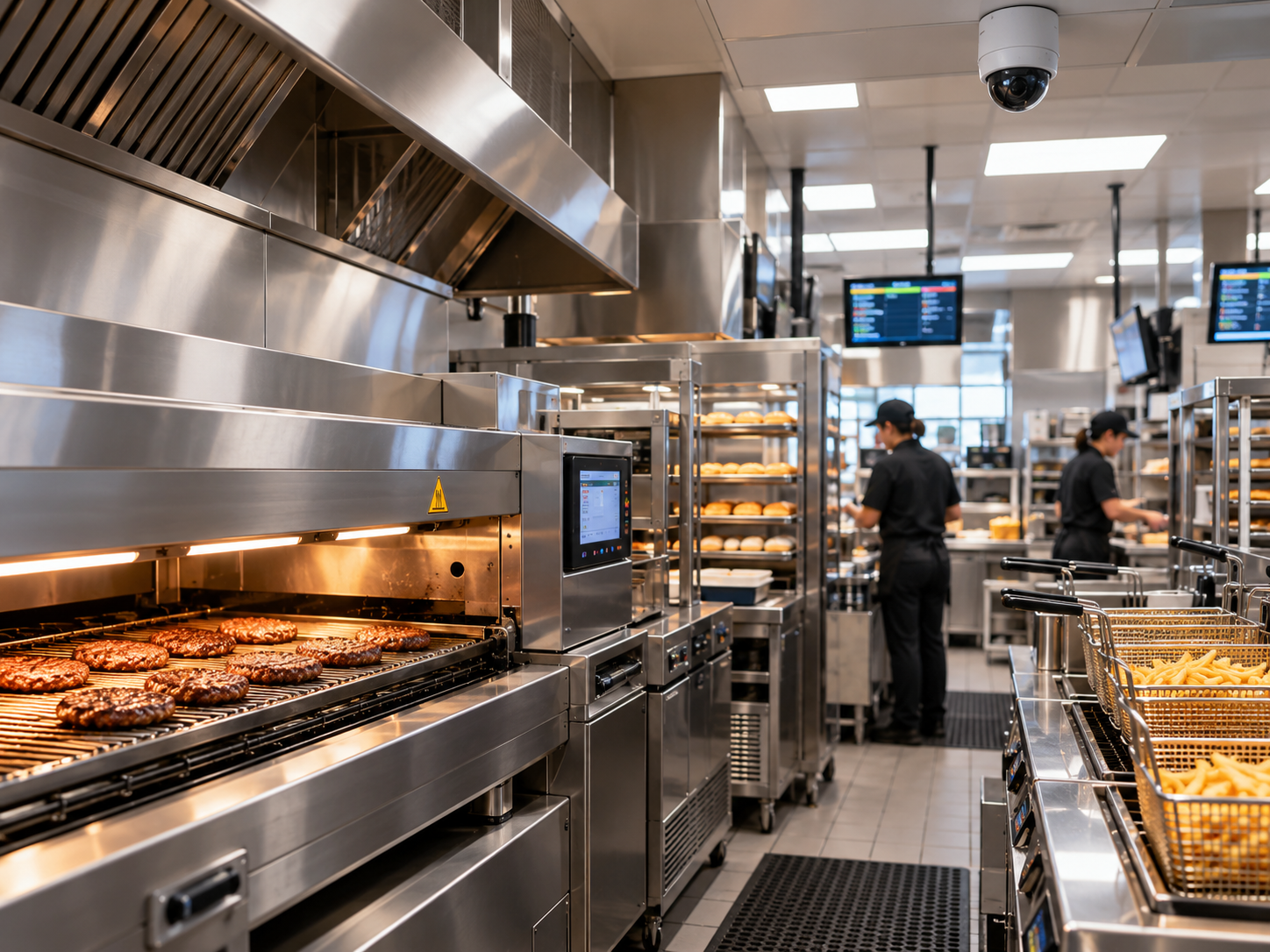
In a quick-service restaurant, a burger patty is placed on the grill. FlowLinks detects the item and starts the cook-time clock for that station. When the patty reaches the configured time limit, an alert is sent to the grill station screen or kitchen display. If the patty is not removed within the alert window, a second escalation can be triggered to the kitchen manager.
The same logic applies to fryers, chicken stations, and any prep station with camera coverage. Cooking time monitoring is part of the wider AI video analytics for restaurants that FlowLinks provides across front-of-house and back-of-house operations.
Benefits
Alerts fire before food crosses the limit — giving kitchen staff time to act rather than discard.
All staff on all shifts follow the same cooking time targets — not just experienced hands who know by instinct.
Fewer discarded overcooked items means direct savings on food cost across every service.
Compatible existing kitchen cameras are used. No additional equipment needed for monitored stations.
Every cook-time event is timestamped and logged — useful for food safety audits and shift reviews.
Multi-location operators can compare cooking consistency across outlets and identify sites that need process support.
Who it's for
High-volume grill and fryer stations where speed and consistency both matter — and missed cook times show up in waste and complaints.
Table-service kitchens where cook standards need to hold across shifts and across a full menu.
Ovens, grills and toasting stations where time-sensitive items move quickly and oversight is manual.
Delivery-only kitchens where food quality cannot be corrected after it leaves — getting it right on the grill matters more.
Chains where kitchen standards need to hold consistently across every site without requiring a manager at every station.
By the numbers
Also in restaurants & cafes
Frequently Asked Questions
Book a demo and we'll show FlowLinks monitoring cook times on your grill and fryer stations — using your existing CCTV.
Book a demo