How to Prevent Employee Theft in Retail: The Cash Drawer Opened, but Where Was the Sale?

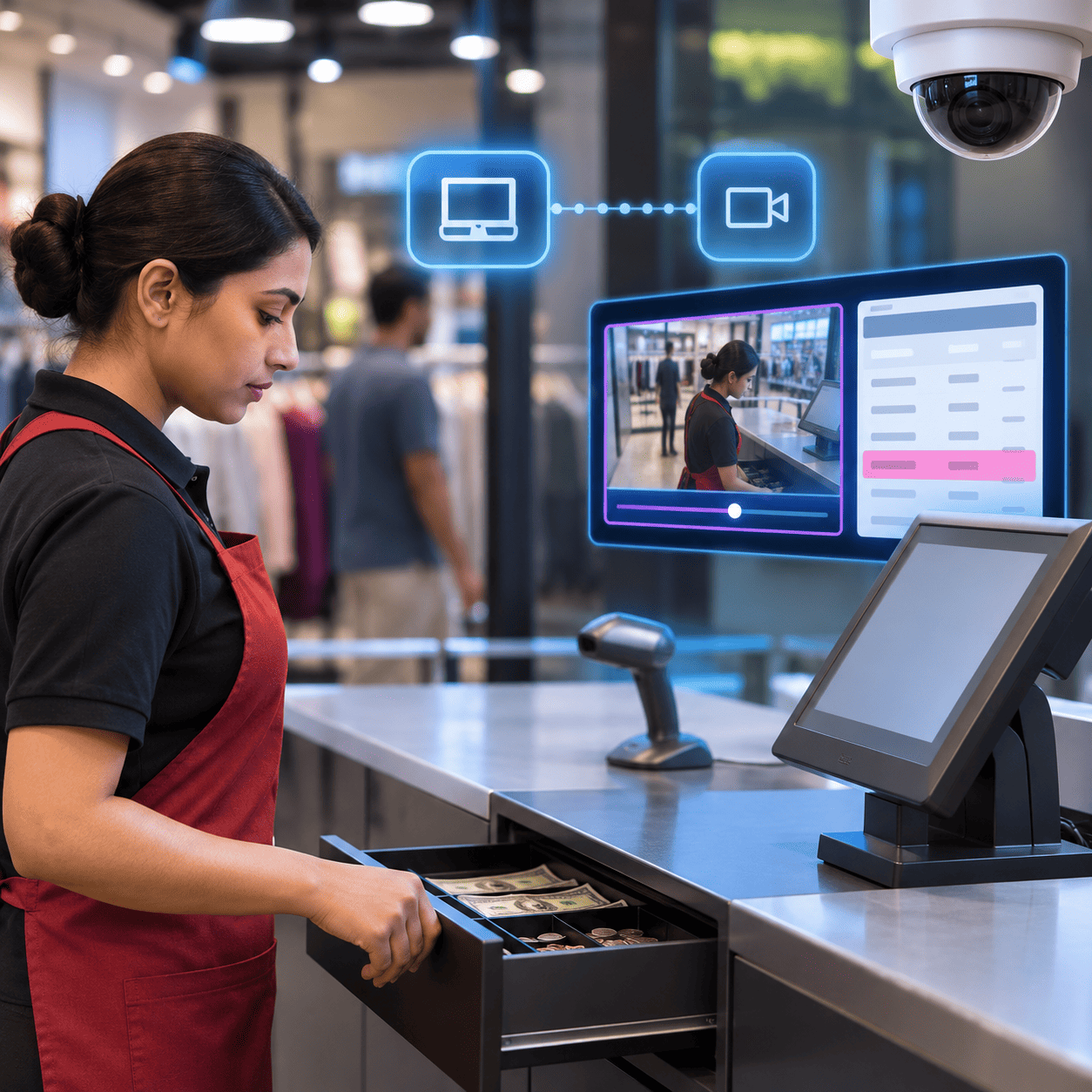
Discover how retailers can prevent employee theft, investigate suspicious cash drawer events, and strengthen loss prevention with POS data and existing CCTV.
The checkout counter is busy. A cashier completes a transaction, hands the customer a receipt and prepares for the next sale. A few minutes later, the cash drawer opens again. But this time, there is no corresponding sale in the point-of-sale (POS) system.
Was the cashier making change? Was there an authorized cash adjustment? Did someone use the drawer-opening function for a legitimate reason, or does the event require further investigation?
A store manager reviewing the daily sales report may never notice that moment. Even if the POS system records a no-sale drawer opening, the transaction log alone may not explain what physically happened at the counter.
This is one of the challenges retailers face when trying to prevent employee theft. The transaction record tells part of the story, but the surrounding activity often provides the missing context.
For retailers operating multiple stores, preventing internal losses requires more than periodic cash reconciliation. It requires clear procedures, consistent exception reviews and reliable evidence when something unusual occurs.
Why Employee Theft Is a Retail Loss Prevention Challenge
Retail shrinkage refers to losses associated with inventory differences, including theft, administrative errors and operational failures. While shoplifting receives significant attention, losses originating within retail operations also matter.
According to the National Retail Federation's 2023 National Retail Security Survey, US retail respondents reported an average shrink rate of 1.6% for fiscal year 2022, representing an estimated $112.1 billion in losses across US retail.
The survey attributed approximately 29% of respondents' shrink losses to internal or employee theft, while process and control failures accounted for another 27%.
These figures are historical US industry estimates, not a measure of current employee theft in every country or retail business. They nevertheless illustrate why retailers should look beyond external shoplifting when evaluating preventable losses.
Employee-related retail losses may involve cash handling, unauthorized discounts, refunds, inventory access or manipulation of transactions. However, not every discrepancy indicates deliberate misconduct. Incorrect entries, unclear procedures and system integration problems can also create anomalies.
Effective retail loss prevention begins by distinguishing suspicious activity from ordinary mistakes.
Where Employee Theft Can Occur in Retail Stores
Employee theft does not always involve someone visibly removing cash or merchandise. Some risks arise through routine business processes that employees are authorized to perform.
No-sale cash drawer openings. A drawer may open without a completed sale. Legitimate reasons include making change or approved cash handling, but repeated unexplained openings deserve review.
Unusual refunds and voids. A refunded or cancelled transaction may require additional investigation when it does not correspond with normal customer activity, product returns or authorization procedures.

Unauthorized discounts. Employees may apply discounts outside approved policies, intentionally or because the system allows excessive discretion.
Cash reconciliation discrepancies. Differences between expected cash and physically counted cash can indicate mistakes, procedural weaknesses or potential losses.
Unauthorized access to checkout areas. An individual entering a restricted till area may create a cash-handling risk, even when no transaction occurs.
These activities should be evaluated in context. A single exception is not proof of theft, and retailers should avoid making accusations before reviewing available evidence.
How to Prevent Employee Theft in Retail: Practical Controls That Matter
The strongest approach to employee theft prevention combines clear operating procedures with consistent monitoring, staff training and fair investigation processes.
The Association of Certified Fraud Examiners' 2026 Report to the Nations highlights the value of internal controls, management reviews and proactive data monitoring. The research also shows that prolonged fraud schemes can produce substantially greater financial losses.
For retail businesses, several practical controls are particularly relevant.
Establish Clear Cash-Handling Procedures
Every store should define when a cash drawer may be opened, who can approve refunds or adjustments, and how exceptions should be documented.
Staff should understand these rules before operating the register. Well-defined procedures reduce ambiguity and help managers distinguish authorized activity from unexplained events.
Review POS Exception Reports Regularly
Most retail POS environments can provide transaction information that managers can use to investigate exceptions, depending on the system and available configuration.
Reviewing unusual voids, refunds, discounts and no-sale events can reveal patterns that ordinary daily sales summaries may overlook.
Rather than examining only transaction totals, managers should consider how often exceptions occur relative to transaction volume, store workload and approved operating practices.
Separate Authorization and Reconciliation Duties
Where staffing permits, the same person should not control every stage of a sensitive transaction and its subsequent review.
Manager approval for selected refunds, independent cash counts and documented reconciliation procedures can strengthen accountability without slowing normal checkout activity unnecessarily.
Use Training and Consistent Feedback
Employees should understand both the operational reasons for cash controls and the procedures for reporting mistakes.
A prevention programme should encourage accurate reporting, avoid unfair assumptions and apply the same standards across employees and locations.
Investigate Patterns Rather Than Isolated Events
One unexpected drawer opening may be harmless. Repeated unexplained openings, unusual refund patterns or recurring reconciliation differences warrant a more structured review.
The aim is to identify the underlying cause, whether that is a training problem, system configuration issue, weak control or potential misconduct.
Why POS Reports Alone May Not Explain What Happened
A POS transaction report provides a record of events recognized by the transaction system. It may show when a refund was processed, when a sale was voided or when a no-sale function was used.
What it cannot always explain is the physical activity surrounding that event.
Consider a refund completed at 6:42 PM. The POS report may contain the transaction amount, timestamp and operator information. But was a customer present? Was merchandise returned? Did the cashier follow the approved refund process?
Without additional context, managers may need to search through CCTV recordings manually.
Likewise, a cash drawer can appear balanced at the end of a shift even when particular transaction events deserve investigation. A correct final cash total does not independently verify every action that occurred at the register.
This is where retailers can benefit from linking POS information with existing camera footage, provided that synchronization, system integration and video quality are sufficient.
How Existing CCTV Can Support Retail Employee Theft Prevention
Traditional CCTV provides visual evidence of activity at the checkout counter. However, without a connection to transaction data, locating a particular event may require manually searching recordings.
Camera-assisted POS monitoring can help associate selected transaction events with corresponding video evidence.
For example, when a configured no-sale event occurs, a monitoring workflow can identify the relevant till, timestamp and camera footage for review. If visual drawer activity and POS records do not match, the difference can be flagged for investigation.
Similarly, refund events can be reviewed alongside visible customer interactions, where the camera angle provides sufficient context.
A practical investigation might look like this:
POS or till event | What managers should verify |
|---|---|
Drawer opened without a sale | Whether the event was authorized and correctly recorded |
Refund completed | Whether the refund followed policy and corresponds to a legitimate return |
Transaction voided | Whether the cancellation was justified and approved |
Cash discrepancy | Whether counts, adjustments and transaction records reconcile |
Restricted till access | Whether the individual was authorized to enter the area |
CCTV does not establish criminal intent. It helps provide additional evidence so managers can examine events more accurately.
How FlowLinks Supports Till and Cash Drawer Monitoring
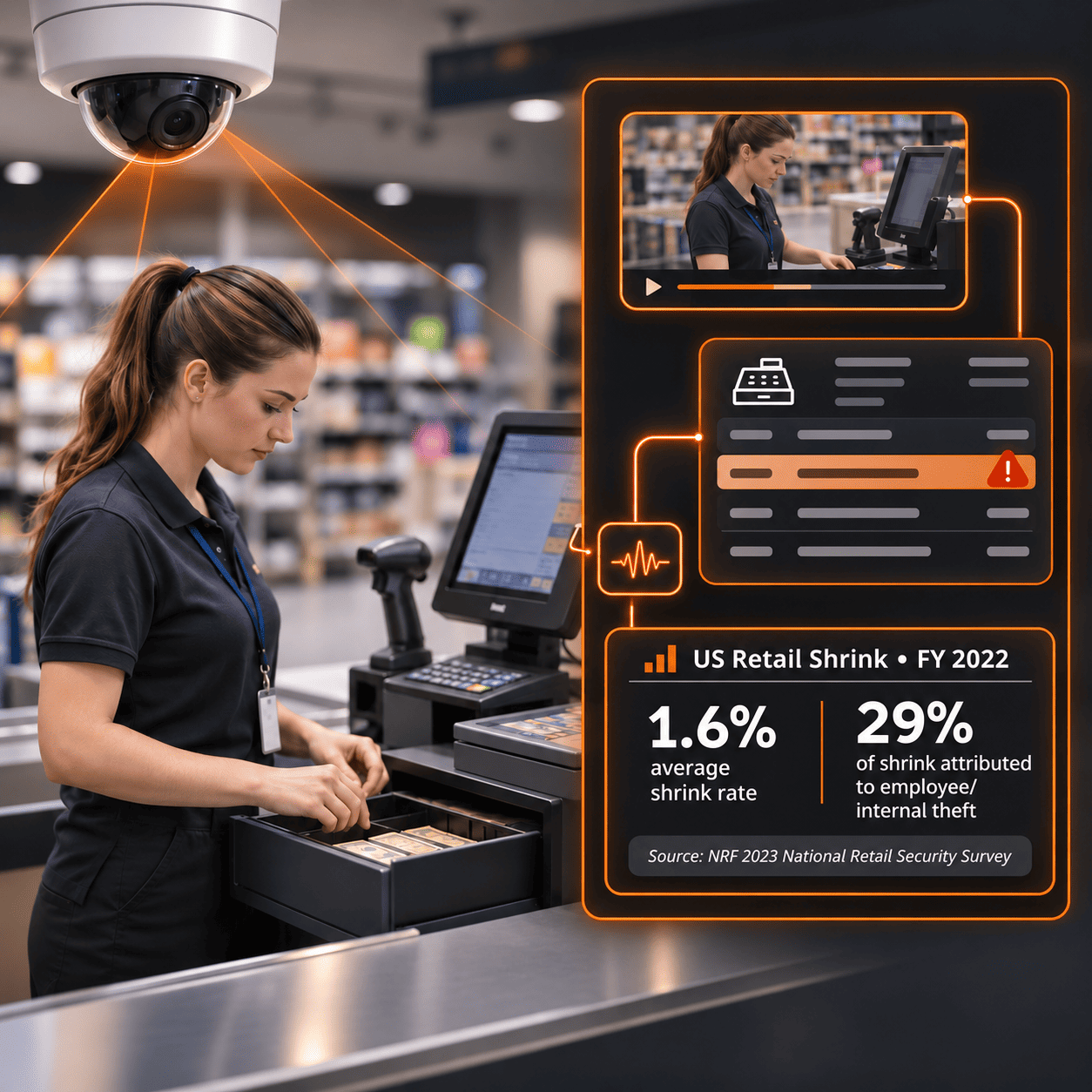
FlowLinks.ai provides AI video analytics designed to work with compatible existing CCTV cameras, helping retail teams monitor activity and investigate operational exceptions.
Its Till & Cash Drawer Anomalies solution is designed to connect observable till activity with available POS transaction information.
A typical configured workflow begins with cameras covering checkout counters. FlowLinks processes relevant video activity and, where supported POS integration is available, compares configured till events against transaction records.
When the system identifies a mismatch or defined anomaly, it can generate an alert and associated visual evidence for authorized managers to review.
For example, a drawer-opening event without a matching sale may be flagged, allowing the manager to review the timestamped event and available transaction information.
The solution also addresses operational concerns such as unattended tills, unusual refund-related activity and access to checkout areas.
The important distinction is that FlowLinks helps retailers identify and investigate anomalies, rather than automatically concluding that an employee committed theft.
The exact detection and reporting capabilities depend on camera positioning, POS integration, event configuration and deployment conditions.
The Value of Recurring Patterns Across Stores and Shifts
A retailer operating several locations may see a small number of unusual till events in individual stores. Viewed separately, those events can appear unimportant.
However, reviewing patterns over time may reveal operational issues that warrant attention.
For example, one store might experience frequent authorized no-sale openings during shift handovers because its cash-change procedure differs from other branches. Another store may show repeated refund exceptions associated with a particular checkout workflow.
These patterns do not necessarily indicate employee theft. They may reveal inconsistent training, overly permissive system settings or procedures that should be standardized.
The useful question is not simply how many alerts occurred. It is whether the alerts reveal a repeatable problem that managers can investigate and correct.
This approach complements broader retail theft and loss prevention, where organizations need to address both external threats and internal operational weaknesses.
What AI Monitoring Cannot Determine on Its Own
AI-assisted monitoring can improve the visibility of selected checkout events, but it cannot replace accurate POS data, human judgement or fair investigation procedures.
Camera obstruction, low image quality, incorrect timestamps and incomplete POS integration can produce missing or misleading evidence. Legitimate cash handling may also trigger an exception.
A monitoring system cannot reliably determine intent simply because a drawer was opened or an employee performed an unusual action.
Retailers should therefore validate alerts before taking action, preserve relevant evidence, restrict access to recordings and follow applicable employee privacy and data-protection requirements.
How Retailers Can Start With a Practical Monitoring Pilot
A retailer does not need to begin with every checkout counter across every branch.
A focused pilot can start with a small number of tills that have appropriate CCTV coverage and access to reliable transaction data.
The implementation team should confirm that camera timestamps and POS timestamps are synchronized. It should then define which events require review, such as drawer openings without matching sales, unauthorized till access or selected refund exceptions.
During the pilot, managers can compare alerts against transaction records and manually reviewed footage to evaluate accuracy.
Useful measurements include the percentage of valid anomalies detected, false alerts, time required to investigate exceptions and the number of operational issues that can be resolved through better procedures.
The goal is to establish whether camera-linked transaction monitoring adds dependable information to existing retail controls before expanding the deployment.
Conclusion: Prevent Losses by Understanding What Happened
Preventing employee theft in retail is not simply a matter of installing more cameras or reviewing more reports. It requires clear policies, reliable transaction records, consistent oversight and a fair process for investigating unusual events.
An unexplained cash drawer opening is a reason to ask a question, not an automatic indication of wrongdoing.
By combining POS exception reporting with relevant CCTV evidence, retailers can better understand checkout activity, identify recurring risks and improve internal controls.
For retail businesses managing multiple shifts, counters and locations, the value lies in making investigations more timely, consistent and evidence-based.
Turn Existing Till Cameras Into Actionable Insights
FlowLinks helps retailers monitor configured cash drawer events, investigate POS anomalies and review supporting video evidence using compatible existing CCTV systems.
Explore FlowLinks Till & Cash Drawer Anomalies to understand how camera-linked monitoring can support checkout oversight and retail loss prevention.
Book a demo to evaluate your existing till cameras and explore a practical monitoring pilot.
Pro Tip:
A single cash drawer opening or unusual refund does not necessarily indicate theft. Review recurring POS exceptions alongside synchronized CCTV footage to identify patterns, verify legitimate activity, and investigate potential losses fairly.
Conclusion
Preventing employee theft in retail requires more than cash reconciliation and periodic checks. Clear procedures, regular POS exception reviews, and reliable CCTV evidence help retailers identify suspicious patterns and strengthen internal controls. By connecting transaction records with existing camera footage, retailers can investigate unusual cash drawer activity more efficiently, reduce blind spots, and make evidence-based decisions without assuming every anomaly indicates theft.
Turn Existing CCTV Into Smarter Checkout Monitoring
Discover how FlowLinks helps retailers identify cash drawer anomalies, review POS exceptions, and investigate unusual checkout activity using existing cameras.
Book a 20-minute demo