Hospital Hand Hygiene Audits: What Manual Checks Miss and How AI Monitoring Can Help

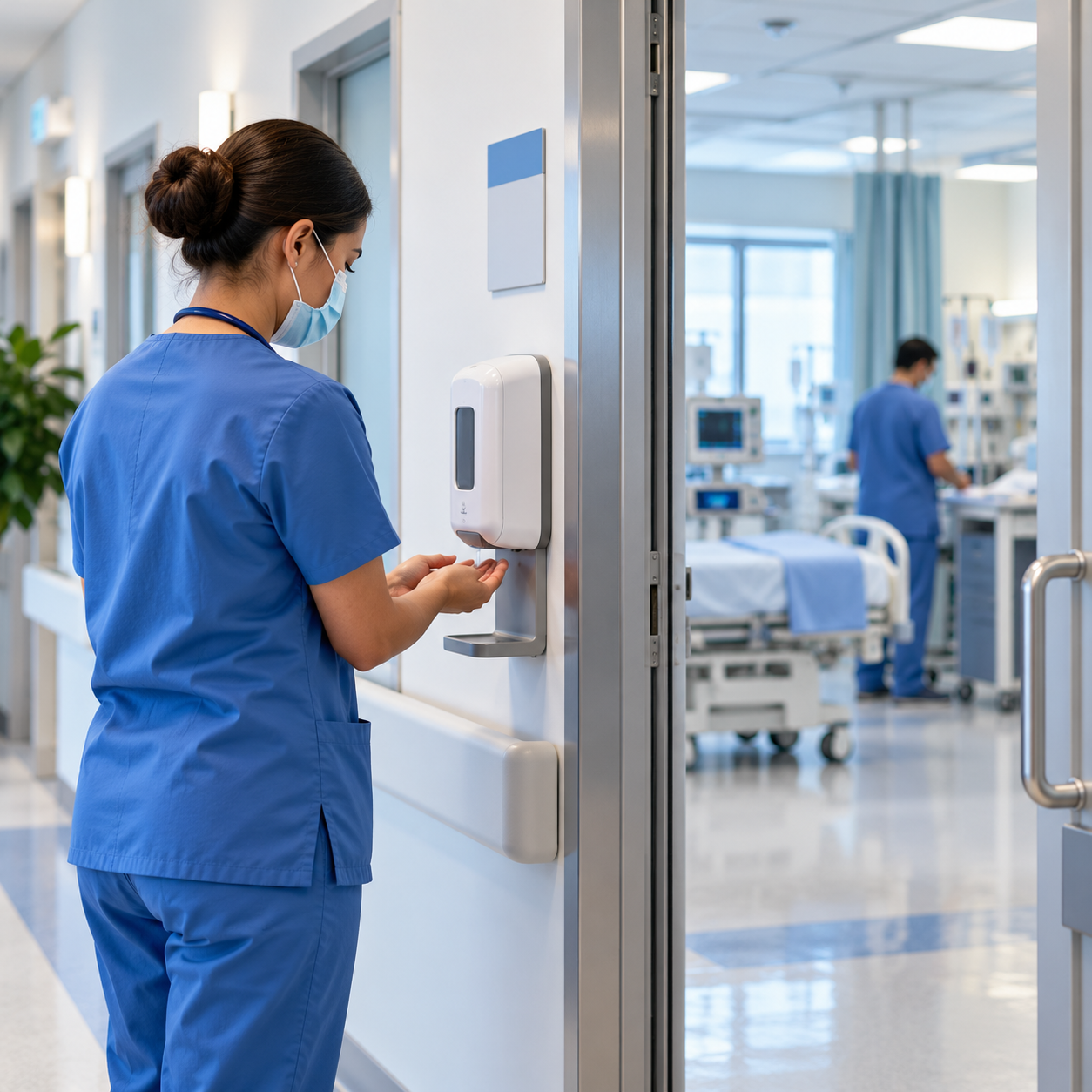
Discover why traditional hospital hand hygiene audits miss compliance gaps and how AI-powered CCTV monitoring helps hospitals improve visibility, identify patterns, and support infection prevention.
A nurse enters a hospital ward during a busy shift. Before entering, they use the hand sanitizer station near the doorway. Later, more staff members pass through the same entrance as they move between patient care, medication administration and other responsibilities. Some use the sanitizer station; others may have cleaned their hands elsewhere, while some opportunities may be missed.
During a scheduled hand hygiene audit, an observer records the actions visible within a limited observation period. The hospital receives a compliance score, but an important question remains: what happened during the hours when nobody was observing?
This is one of the limitations of traditional hospital hand hygiene audits. They provide valuable information about infection prevention practices, but cannot continuously capture every relevant activity across different wards, entrances and shifts.
AI-assisted video monitoring offers an additional way to observe selected hygiene stations and identify operational patterns. For hospitals with suitable existing CCTV coverage, it can supplement established audit procedures without requiring every monitoring activity to depend on manual observation.
What Does a Hospital Hand Hygiene Audit Actually Measure?
A hand hygiene audit evaluates whether healthcare personnel perform hand hygiene when required during patient care. Trained observers typically identify hand hygiene opportunities, record whether appropriate actions occur and calculate compliance using the number of observed actions relative to opportunities.
The World Health Organization's Guidelines on Hand Hygiene in Health Care identify direct observation as an important method of assessing hand hygiene practices because observers can consider clinical context, the timing of actions and the sequence of care.
Under the WHO Five Moments framework, hand hygiene is required at specific points, including before touching a patient, before a clean or aseptic procedure, after body fluid exposure risk, after touching a patient and after touching patient surroundings.
However, the visibility provided by an audit depends on where, when and how observations are conducted. A ward entrance audit, for example, cannot establish whether every hand hygiene opportunity inside a patient care area was addressed.
Why Manual Hand Hygiene Audits Can Miss Compliance Gaps
Manual observation remains valuable, particularly when hospitals need to assess technique, provide staff feedback or investigate clinical practices. However, relying exclusively on occasional observation creates several operational challenges.
Limited observation periods. Infection control teams cannot be present at every hygiene station throughout every shift. Audits therefore represent samples of activity rather than complete records.
Changes in behaviour during observation. Healthcare workers may alter their behaviour when they know an audit is taking place. This is commonly referred to as the Hawthorne effect.
Uneven coverage across locations and shifts. Observations conducted during routine daytime hours may not adequately represent activity during night shifts, staff handovers or particularly busy periods.
Differences between observers. Audit quality depends partly on consistent definitions, observer training and how accurately opportunities and actions are recorded.
The 2022 SHEA/IDSA/APIC practice recommendations discuss these limitations, including observation-related bias and the role of electronic monitoring methods.
The concern is not that traditional audits are ineffective. It is that a hospital's recorded audit score may not describe everything happening outside the observation period.
A Practical Hand Hygiene Audit Checklist for Hospitals
Before introducing additional monitoring technology, hospitals should establish a consistent audit process. A practical hand hygiene audit checklist can help infection prevention teams make their findings more representative and actionable.
Audit area | What to check |
|---|---|
Observation locations | Include appropriate wards, clinical areas and hygiene stations |
Timing | Cover representative shifts, workloads and handover periods |
Hand hygiene opportunities | Apply consistent definitions based on established clinical guidance |
Actions performed | Record whether the required hand hygiene action occurred |
Technique | Assess technique where suitable direct observation is possible |
Reporting | Review findings by location, time period and relevant workflow |
Follow-up | Document training, feedback and corrective actions |
Hospitals should also consider whether their observations adequately represent the areas where infection prevention risks are greatest.
For example, observing a main ward entrance may help evaluate station-use behaviour at that location. It does not automatically provide evidence of hand hygiene before an aseptic procedure or after touching patient surroundings.
The objective should be to collect meaningful information that helps teams improve practices, rather than simply increasing the number of observations recorded.
What Existing CCTV Can Add to Hand Hygiene Monitoring
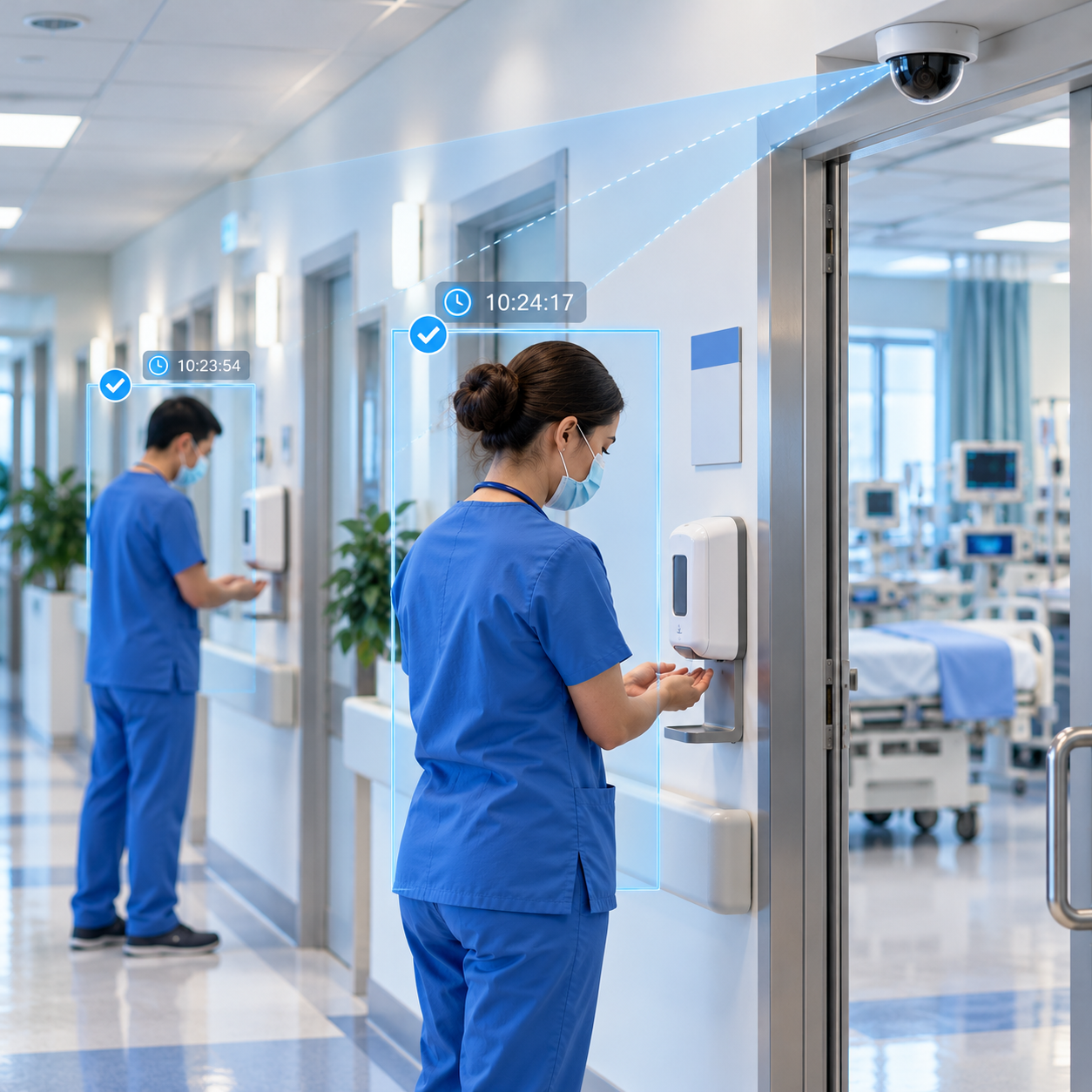
Many hospitals already use CCTV for security, access monitoring and incident investigation. Where camera placement, image quality and privacy requirements permit, the same infrastructure may support selected operational monitoring activities.
AI video analytics can be configured to monitor visible activity around designated sanitizer stations, ward entrances or other relevant areas.
For example, a camera covering a ward entrance may provide information about movement through the doorway and observable interaction with a nearby sanitizer station. The system can record configured events with associated times and locations, allowing authorized staff to review activity patterns.
Unlike a scheduled manual observation, automated monitoring can operate across configured monitoring periods without requiring an observer to watch every camera continuously.
However, the measurements must be interpreted carefully. A detected station interaction is not necessarily proof of correct hand hygiene, and a person walking past a station may have performed hand hygiene elsewhere.
Research on electronic hand hygiene monitoring systems also identifies limitations involving camera placement, system accuracy and incomplete observation of clinical hand hygiene opportunities.
For this reason, CCTV-based monitoring is best understood as an additional source of operational evidence, rather than a replacement for clinically validated hand hygiene audits.
How FlowLinks Supports Hand Hygiene Monitoring Using Existing CCTV
FlowLinks.ai provides AI video analytics designed to help organizations use compatible existing CCTV cameras for operational monitoring.
Its hand hygiene compliance monitoring solution focuses on observable activity around configured hygiene stations and clinical access points.
A typical monitoring workflow starts by identifying a suitable camera view and defining the location where relevant activity should be monitored. The analytics system then processes the video according to configured detection conditions.
When an event meets those conditions, the system can generate a timestamped record for authorized staff to review. Depending on the deployment configuration, relevant alerts and reporting information may also be available.
Consider a hospital ward where staff frequently pass through an entrance near a sanitizer station. Instead of depending entirely on occasional observations, the hospital could evaluate patterns of station interactions over different periods.
In this scenario, FlowLinks can support operational visibility by helping staff investigate whether particular entrances or shifts show repeated differences in observable hygiene-station activity.
The purpose is not to label every individual movement as clinically compliant or non-compliant. It is to provide additional evidence that infection prevention teams can evaluate alongside established procedures.
The Patterns That Matter More Than a Single Audit Score
A hospital's hand hygiene audit may indicate that performance needs improvement, but the score alone may not explain where or when the underlying challenges occur.
Repeated observations can reveal more useful operational questions.
Does station usage appear lower during busy handover periods? Are particular entrances associated with fewer observable station interactions? Could the location of a sanitizer dispenser make it less convenient for staff moving between clinical areas?
These patterns can guide practical improvements, such as reviewing dispenser placement, evaluating staff workflows or selecting appropriate locations for additional manual audits.
For example, if a monitored ward entrance consistently shows fewer station interactions during certain periods, the infection prevention team can investigate the context. There may be a visibility issue, an alternative sanitizer location or a genuine opportunity for improvement.
The value lies in identifying recurring patterns that deserve investigation, rather than treating every individual event as evidence of misconduct.
This approach also reflects a broader opportunity for AI video analytics in healthcare facilities: using existing cameras to support operational awareness alongside established safety and clinical processes.
What AI Hand Hygiene Monitoring Cannot Confirm
AI video analytics has important limitations, particularly when used in healthcare environments.
A camera observing a sanitizer station cannot automatically establish that every step of an appropriate hand hygiene technique was completed. Even when a dispenser interaction is visible, the system may not be able to determine whether the correct product amount was used or whether sufficient hand coverage was achieved.
Camera angle, lighting, crowding and physical obstructions can also affect detection accuracy.
More importantly, many clinical hand hygiene opportunities occur away from monitored entrances or within patient care areas where cameras may be unsuitable because of privacy requirements.
The WHO guidance on monitoring approaches distinguishes between direct observation and indirect measures, highlighting that automated or product-use measurements may not capture every relevant hand hygiene opportunity.
Consequently, hospitals should avoid presenting station-interaction data as a complete WHO Five Moments compliance rate unless the measurement method has been appropriately validated.
Patient privacy, staff transparency, controlled access to footage and relevant local data-protection requirements should also be addressed before deployment.
How Hospitals Can Pilot Camera-Assisted Hand Hygiene Monitoring
A practical pilot can help determine whether existing CCTV adds meaningful information to a hospital's hand hygiene improvement programme.
Rather than beginning with every ward, hospitals can select one or two suitable locations where sanitizer stations and movement patterns are clearly visible.
The infection prevention and technical teams can then establish which observable events the system should identify, how results will be reviewed and what operational questions the pilot should answer.
A useful evaluation should compare AI-generated records with appropriately collected reference observations, including missed detections, false alerts and situations where camera footage cannot support a reliable conclusion.
Hospitals may also examine whether the additional information reveals differences across shifts, supports more targeted audits or improves the efficiency of operational reviews.
The pilot should involve infection prevention professionals, IT and relevant privacy or governance stakeholders. Its success should be measured by the reliability and usefulness of the information produced, not simply by the number of events recorded.
For hospitals operating in India, the UAE or the United States, this evaluation can be aligned with applicable organizational infection prevention policies and local requirements without assuming that video monitoring itself establishes regulatory compliance.
From Periodic Audits to Better Operational Visibility
Hand hygiene audits remain an essential part of hospital infection prevention. They provide clinical context, support staff education and help organizations evaluate whether established practices are being followed.
Their limitation is that no scheduled observation programme can continuously describe every relevant activity across an entire healthcare facility.
AI-assisted monitoring can help narrow selected visibility gaps by providing additional information about observable station activity, movement patterns and configured monitoring events.
When the data is interpreted correctly, it can help infection prevention teams identify where further investigation or improvement may be worthwhile.
The goal is not to replace clinical judgement with automation. It is to combine the strengths of manual assessment with better visibility into activities that might otherwise go unreviewed.
Turn Existing Healthcare CCTV Into Operational Insight
Hospitals may already have cameras covering relevant entrances and sanitizer stations. With suitable camera placement and carefully validated monitoring rules, those cameras can become an additional source of operational information.
Explore FlowLinks Hand Hygiene Compliance Monitoring to understand how AI video analytics can support selected hygiene-station monitoring activities using existing CCTV infrastructure.
Assess your hospital's existing camera coverage and identify where an appropriately scoped monitoring pilot could add value.
Pro Tip:
A hand hygiene audit score only reflects observed opportunities. Combine manual audits with camera-assisted monitoring of visible sanitizer-station activity to identify recurring patterns across shifts, while keeping clinical compliance assessment under human oversight.
Conclusion
Manual hand hygiene audits remain essential for hospital infection prevention, but periodic observations cannot capture every activity across wards and shifts. AI-assisted video monitoring can provide additional visibility into sanitizer-station interactions and help identify patterns worth investigating. By combining established auditing practices with carefully validated monitoring technology, hospitals can strengthen operational awareness without replacing clinical judgement or compromising patient privacy.
Improve Hand Hygiene Visibility With Existing CCTV
Discover how FlowLinks helps hospitals monitor observable hygiene-station activity, identify recurring patterns, and support infection prevention teams using compatible existing cameras.
Explore Hand Hygiene MonitoringSources & Citations
- 1.World Health Organization. WHO Guidelines on Hand Hygiene in Health Care — Hand Hygiene as a Performance Indicator.
- 2.SHEA/IDSA/APIC. Strategies to Prevent Healthcare-Associated Infections Through Hand Hygiene: 2022 Update.
- 3.Dubai Health Authority. Health Facility Guidelines — Infection Control and Hand Hygiene.
- 4.Government of India, National Centre for Disease Control. National Guidelines for Infection Prevention and Control in Healthcare Facilities.