The checkout queue your store notices too late

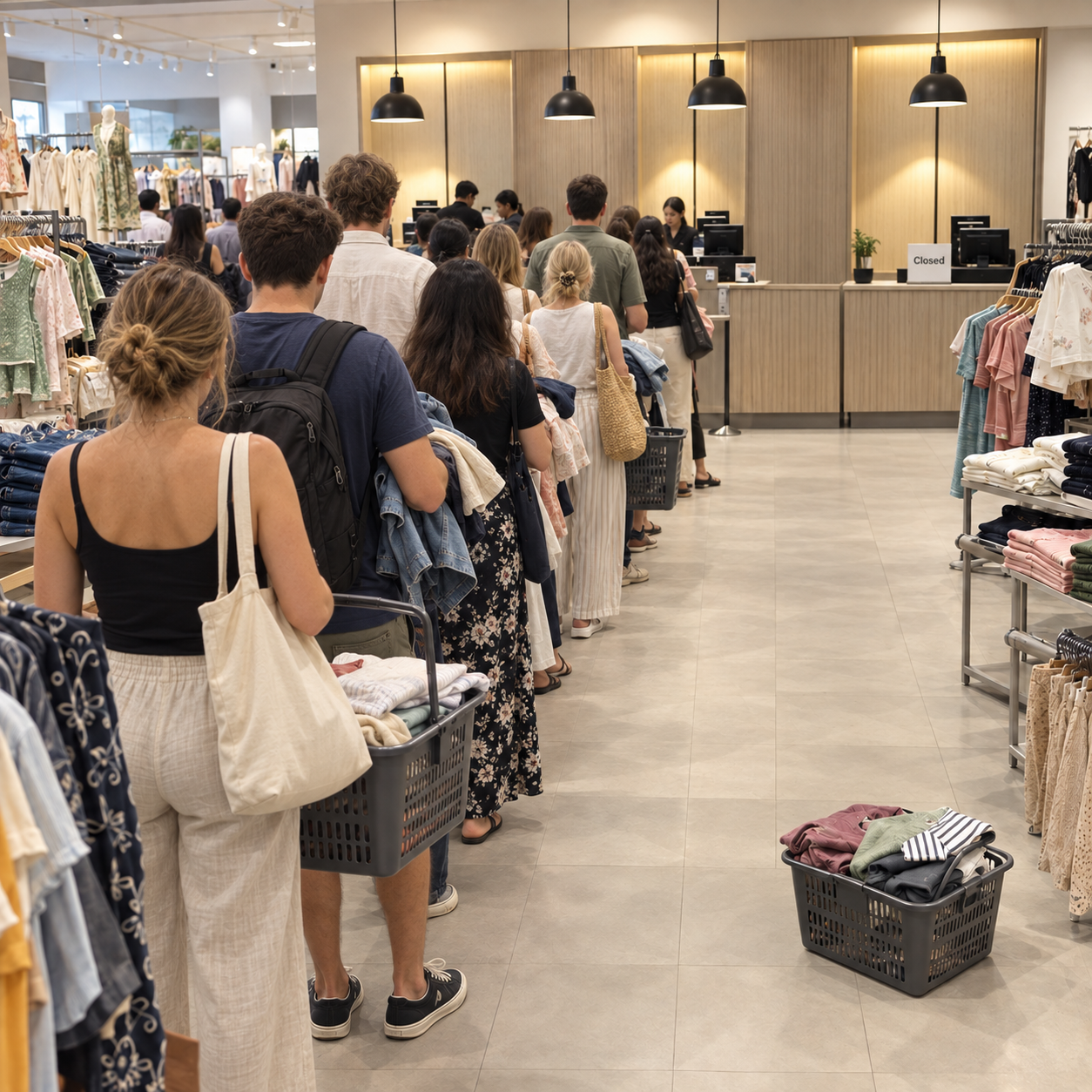
Learn how long checkout queues can lead to lost sales and how existing CCTV can help retailers detect congestion and respond faster.
It is 7:18 on a Saturday evening. One checkout counter is open, six customers are waiting, and a seventh walks toward the line, looks at it for a second, then turns back into the store. The cashier can see the queue, the customers can see it, and the CCTV camera above the checkout has been recording it the whole time.
The person who may not know there is a problem is the person who can actually fix it: the floor manager. By the time another cashier is called over, the queue has already been there for several minutes. Nothing technically failed - the camera worked, the POS worked, and the cashier was working. The problem was simpler: the store could see the queue, but it could not react to it in time.
That distinction matters. Retailers have spent decades trying to make checkout faster, but the operational question is not only how many people are standing in line. It is how long the line has been there, whether it is getting worse, how quickly it is moving, and whether someone knows they need to act. This is where AI video analytics for retail becomes useful: it can turn something the camera already sees into an event the store can respond to.
A queue is not just a customer-service problem
Retailers care about checkout lines because customers care about them too. Research in the Journal of Retailing has found that improvements that reduce waiting time can increase satisfaction with the retailer, and can even influence how shared customers evaluate competing retailers. A 2023 study adds an important nuance: customers are especially positive when a wait is shorter than expected; small overruns may have a limited effect, but satisfaction deteriorates more sharply when the wait becomes much longer than expected.
Operationally, that means a three-minute queue at 11:00 on a quiet Tuesday is not necessarily the same experience as a three-minute queue at 7:00 on a Saturday with two closed counters visible beside it. The clock matters, but so do expectations and what the customer can see happening around them.
The people behind you can make the experience worse too
A long queue does not affect only the people who are waiting. Research on retail service found that the customer already being served can feel social pressure as a line forms behind them. That pressure can worsen the emotional experience of the interaction, reduce participation in the service process, and lower perceived service quality.
A queue can create pressure at the counter before the waiting time becomes extreme.
So queue length is useful information even before a store reaches a dramatic waiting-time number. It can indicate that the checkout experience is becoming strained for both the people in line and the person currently being served.
Some customers never join the queue at all
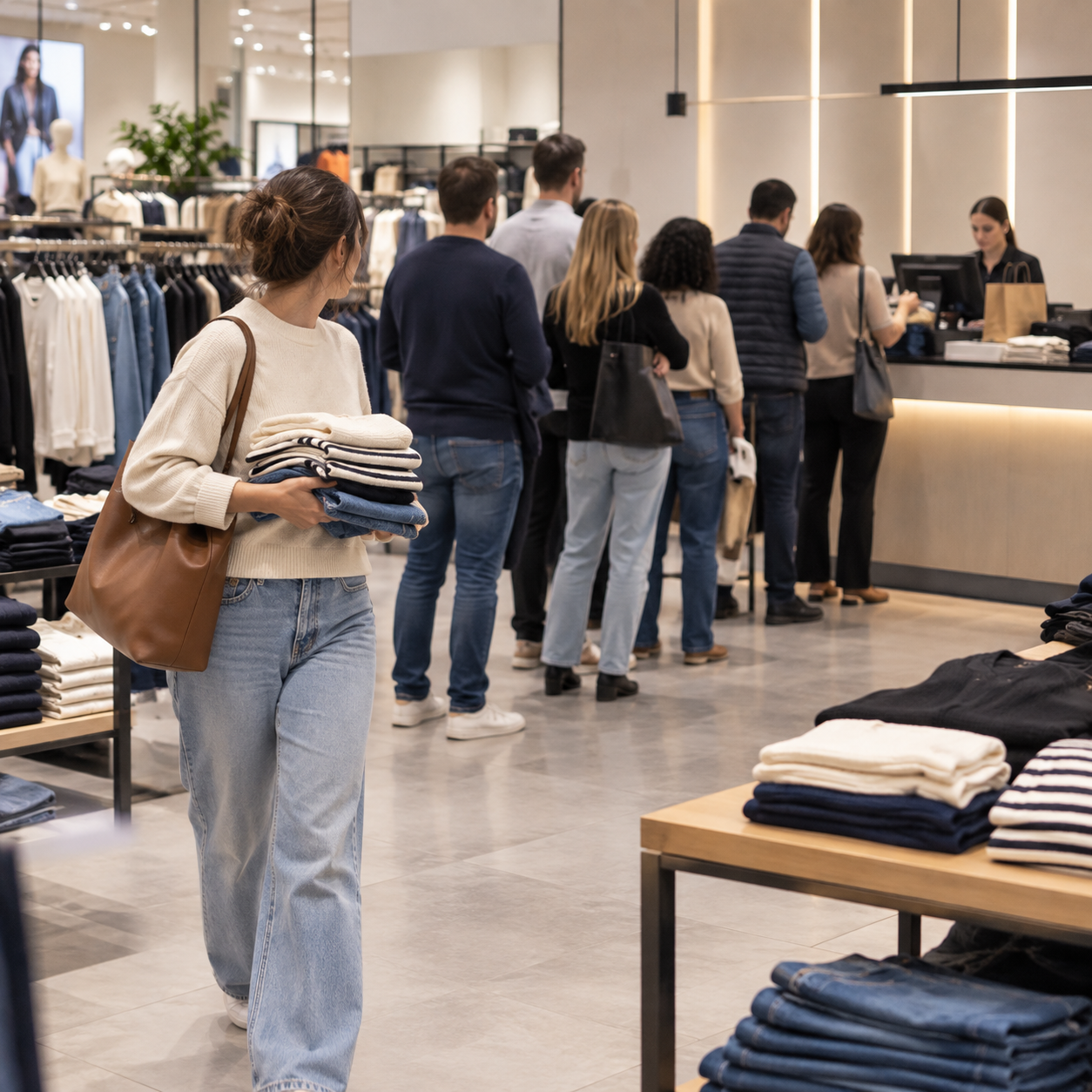
Queueing research uses two useful terms for behaviour retailers see every day. Balking is when a customer sees a queue and decides not to join it; reneging is when a customer joins and then leaves before receiving service. Operations research has studied both because they can represent lost service opportunities and lost sales.
A study of checkout-register policy in convenience stores described lost sales from balking as a major management concern and modelled when another checkout should open based on arrival rates, queue tolerance and expected transaction value. That shifts the useful question from "Did we have a queue today?" to "At what point should the store have responded?" That question is much harder to answer from POS data alone.
Your POS knows who paid. It does not know who looked at the line and walked away.
A POS system provides excellent information once a transaction happens: when the bill was generated, which till handled it, the transaction value, items sold and sometimes service duration. But consider the seventh customer from the opening example. She walked toward checkout, saw six people waiting and turned around. She may have put the product back, left it elsewhere, returned later or left the store completely. There may be no POS event for any of that.
The camera, however, saw the physical situation. That is why visual and transaction data answer different questions. Retailers can also look at footfall and conversion analytics alongside POS data to understand how many people entered versus how many ultimately purchased. At the till, the same video-plus-transaction approach can support till and cash-drawer anomaly monitoring when the operational question is about mismatches between physical activity and recorded transactions.
Counting people is useful. Measuring the queue is better.
Imagine two stores with five people waiting. In Store A, transactions are moving quickly; the line grew from three to five people thirty seconds ago and may clear shortly. In Store B, the same five people have barely moved for four minutes. A system that sees only Queue count = 5 treats those situations as identical. Operationally, they are not.
Useful retail queue monitoring therefore needs a time dimension. It should distinguish between a temporary cluster and a queue that remains above an acceptable level long enough to justify intervention.
When queue condition X persists for Y time, alert someone who can do Z.
For example: more than five people waiting for longer than two minutes -> notify the floor supervisor. That is very different from sending an alert every time five people momentarily stand near a counter.
There is no universal "bad queue"
One of the easiest ways to make a queue-monitoring project noisy is to start with a universal threshold. A premium jewellery store, supermarket, apparel store and convenience store have different service models, and even two branches of the same retailer can behave differently.
A checkout that usually processes a customer every forty seconds needs a different rule from one where billing, packaging and customer conversation routinely take several minutes. The threshold should come from the operation itself. The first few weeks of data are often most valuable for establishing a baseline: understand what normal looks like before deciding what abnormal means.
The camera angle matters more than most people expect
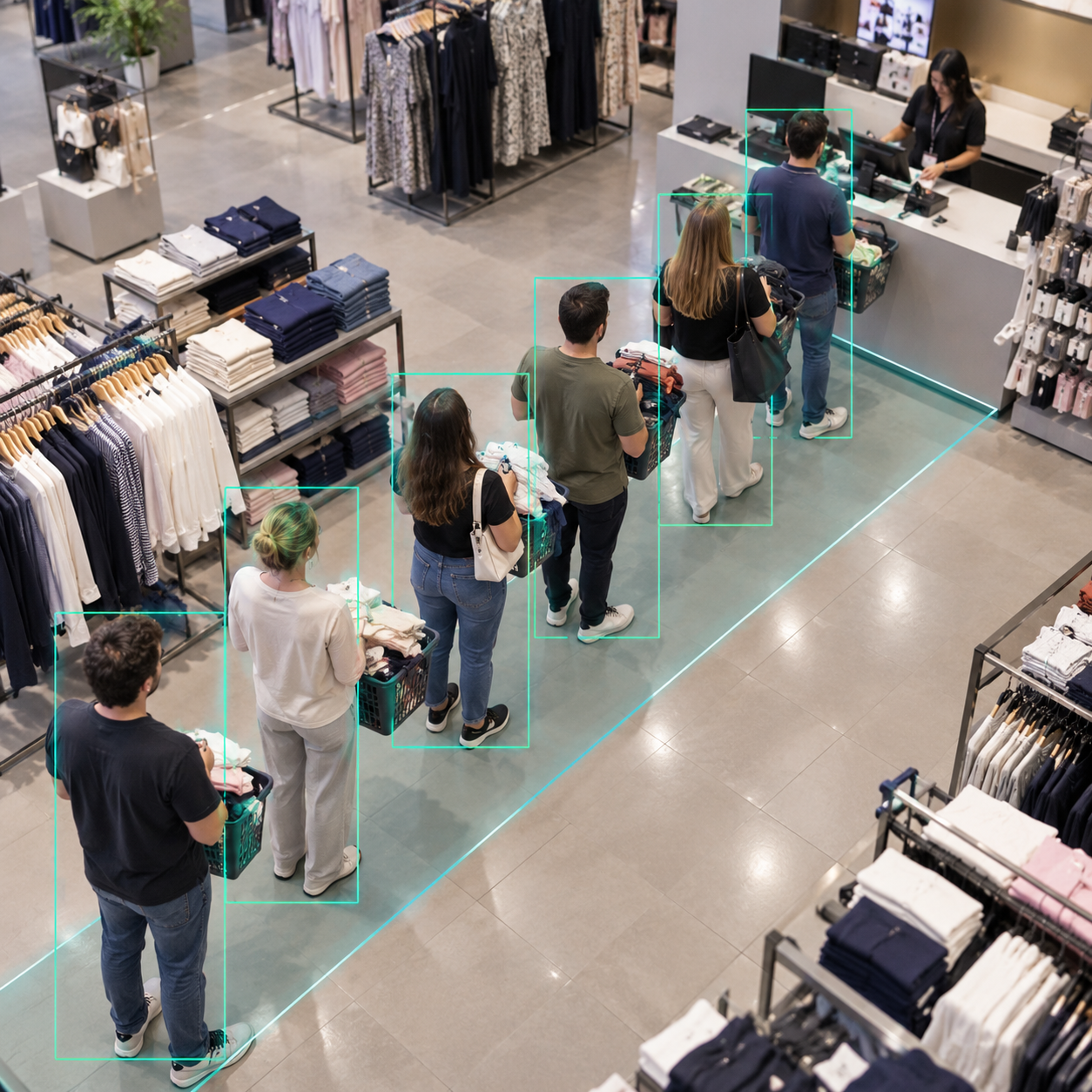
AI cannot measure a queue accurately if the camera cannot see the queue properly. A checkout camera installed primarily to watch the cash drawer may be excellent for transaction monitoring but poor at seeing a line extending several metres behind the customer. An overview camera may cover the whole checkout area, yet heavy overlap between shoppers can make individuals harder to separate.
Pillars, merchandising fixtures and promotional displays can hide sections of a line, and a queue that bends around an aisle can disappear from one view entirely. For queue monitoring, the useful camera is the one that sees the waiting area clearly enough to separate people and understand where the queue begins and ends. Facial identification is normally unnecessary; what matters is scene geometry and visibility.
What AI queue monitoring actually does
This is where FlowLinks enters the picture. FlowLinks can use a retailer's existing CCTV feed and define the part of the scene that represents the checkout queue. The system then watches that zone continuously, monitoring conditions such as how many people are waiting and how long the queue remains beyond a configured threshold.
Camera -> queue zone -> people detected -> threshold persists -> alert -> staff response
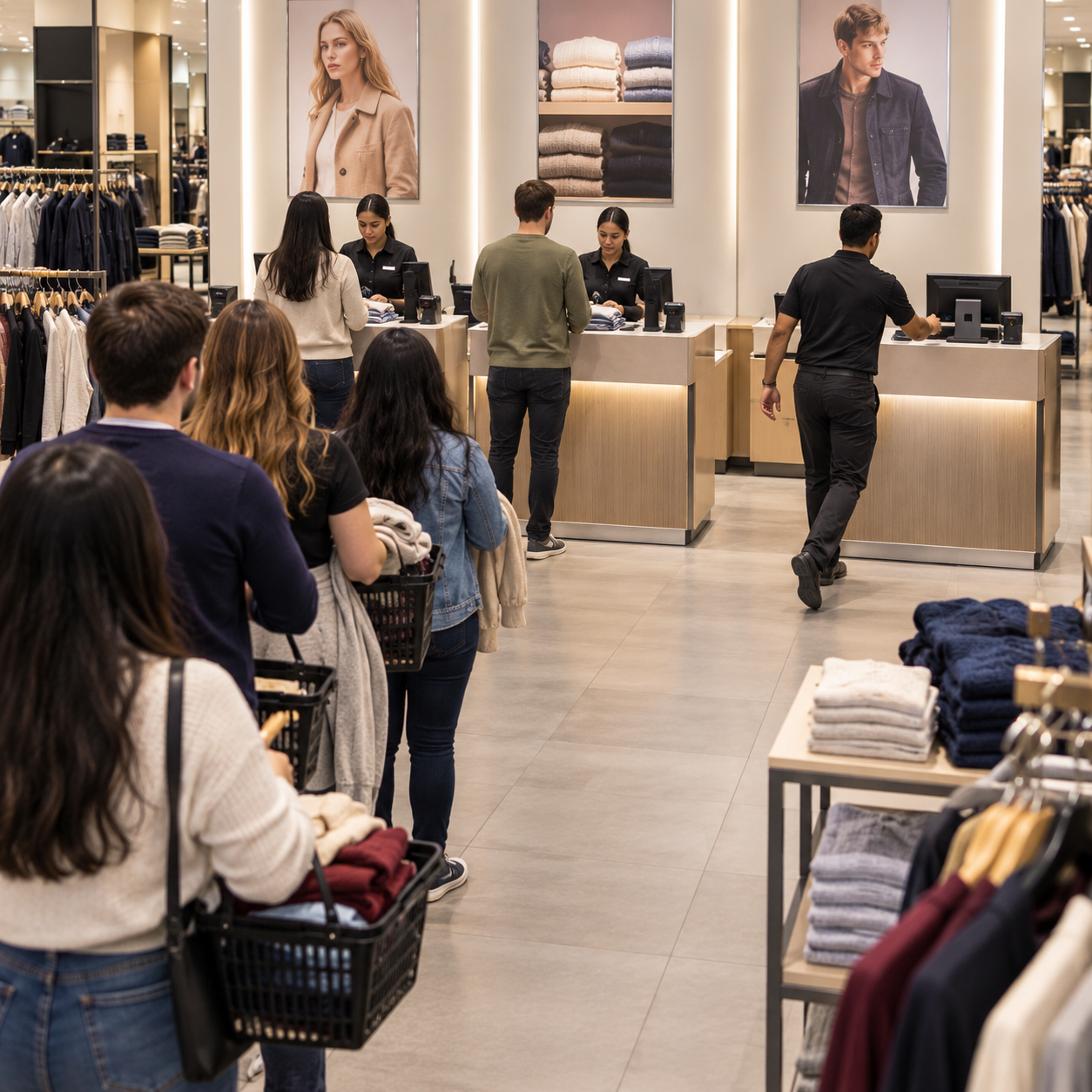
The important part is not that AI can "see a queue" - a human can do that instantly. The useful part is that software can watch the condition throughout the day, across many cameras, and surface the moments that actually require attention.
What should you actually measure?
A pilot should not be judged by the number of AI alerts. More alerts do not necessarily mean a better system. The useful comparison is operational: did the store spend less time above its queue threshold, respond faster, and change staffing or counter-opening behaviour where repeated congestion appeared?
Measure | Before deployment | After deployment |
|---|---|---|
Typical peak queue length | Establish baseline | Compare peak length after interventions |
Time above queue threshold | Baseline minutes / day | Minutes after alerts and staff response |
Threshold-breach frequency | Baseline frequency | Frequency after deployment |
Manager response | How long before someone notices | Alert-to-response time |
Counters open during peak periods | Existing pattern | Response pattern after alerts |
Repeated congestion windows | Identify recurring periods | Check whether staffing was adjusted |
Historical data can answer another useful question: When does this keep happening? If the same store breaches the same threshold between 6:30 and 7:15 every Friday, the issue may no longer be queue monitoring; it may be scheduling. That is when camera data starts becoming operational data.
The question is not whether your store has queues
Every busy store does. The real question is whether you discover them while there is still time to do something about them. In the Saturday-evening example, the camera did not need replacing and the manager did not need another wall of monitors. The store needed a way to turn something its camera was already seeing into an operational event.
Six people. Two minutes. One closed backup counter. Alert the person who can change that.
That is the difference between CCTV that records the queue and video analytics that helps the store respond to it.
Pro Tip:
FlowLinks can evaluate your existing checkout-camera views, define the relevant queue zones and test whether your current footage is suitable for real-time queue monitoring before you replace any camera.
Turn the Cameras You Own Into Real-Time Alerts
See FlowLinks watch your own store's feeds live — and ping your phone the moment something happens.
Book a 20-minute demo